Nubeqa® (Darolutamide)
Cognitive Impact Compared to Other Treatments
SUMMARY
ARACOG, a randomized open-label phase 2 study evaluated cognitive impact between darolutamide and enzalutamide in men with metastatic castration-resistant prostate cancer (mCRPC), metastatic hormone sensitive prostate cancer (mHSPC), and non-metastatic castration-resistant prostate cancer (nmCRPC). 1 Patients (N=111; randomized) received either darolutamide (n=55) or enzalutamide (n=56) for 12 or 24 weeks and could then crossover to the other treatment if eligible.
The primary endpoint was the maximally changed cognitive domain (MCCD) among the 5 Cambridge Neuropsychological Test Automated Battery (CANTAB) tests assessed from baseline to 24 weeks. These tests assess multiple cognitive domains, with individual tests measuring different combinations of executive function, working memory, visual memory, and attention. A statistically significant greater decline in MCCD from baseline to 24 weeks was observed with enzalutamide versus darolutamide (P=0.009):
Darolutamide: PALFAM (visual memory/executive function), median change -15.8%
Enzalutamide: SWM (working memory/executive function), median change -36.1%
At 24 weeks, statistically significant decreases of tests scores of enzalutamide compared to darolutamide were observed in 4 of 5 CANTAB tests assessed.
In the enzalutamide group, 16 of 31 patients who met criteria at week 12 crossed over to darolutamide, and 12 of 17 patients who met criteria at week 24 crossed over. In the darolutamide group, no patients who met crossover criteria at week 12 (n=24) or at week 24 (n=24) crossed over to enzalutamide.
This page is intended for US healthcare professionals and may contain information outside ofthe approved prescribing information. It is provided in response to an unsolicited request. It is not intended as an endorsement ofany usage not contained in the Prescribing Information. This response should be reviewed together with the current full Prescribing Information (including Boxed Warning) and Medical Safety Summary. These materials contain the approved indications, contraindications, warnings and precautions, adverse reactions, and other important safety information for Nubeqa® (Darolutamide)
Nubeqa is an androgen receptor inhibitor indicated for the treatment of adult patients with non-metastatic castration-resistant prostate cancer (nmCRPC), metastatic castration-sensitive prostate cancer (mCSPC), and metastatic castration-sensitive prostate cancer (mCSPC) in combination with docetaxel.
- ODENZA, a randomized, open-label, crossover phase 2 study, evaluated patient preference between darolutamide and enzalutamide in men with asymptomatic or mildly symptomatic mCRPC.2 Patients (N=250; randomized 1:1) received either darolutamide 1200 mg/day or enzalutamide 160 mg/day for 12 weeks (period 1) and then crossed over to the other treatment for an additional 12 weeks (period 2), with no washout between the treatment periods.
- Cognitive assessments (using COGSTATE; secondary objective) showed a statistically significant and clinically meaningful benefit for darolutamide vs enzalutamide in the memory composite in both periods and overall (effect size 0.5 in magnitude; P<0.001).
- Performances were better in the first period than in the second period when averaged over the treatment conditions.
- A moderate benefit in episodic memory from darolutamide was observed both for the acquisition of new information and for the recall of that information after a brief delay.
- A total of 329 adverse events (AEs) (darolutamide, n=170; enzalutamide, n=159) were reported during the first period. Grade 3 AE rates for darolutamide vs enzalutamide, respectively, were 4% vs 6% in phase 1 and 4% vs 7% in phase 2. Grade 4 AEs were reported for 1 enzalutamide patient during period 1 (hypertension), and 1 darolutamide patient during period 2 (adult respiratory distress syndrome).
- Cognitive assessments (using COGSTATE; secondary objective) showed a statistically significant and clinically meaningful benefit for darolutamide vs enzalutamide in the memory composite in both periods and overall (effect size 0.5 in magnitude; P<0.001).
- Ongoing studies are assessing the cognitive impact of androgen receptor pathway inhibitors in the treatment of prostate cancer. These are referenced for your information.3,4
CLINICAL DATA
ARACOG Study
Morgans, et al (2026)1 reported results from the phase 2 ARACOG study which compared cognitive function in US patients with advanced prostate cancer treated with darolutamide or enzalutamide.
Study Design/Methods
- ARACOG (AFT-47) was a randomized, open-label phase 2 study (NCT04335682).1,5
- Patients with mCRPC, nmCRPC, or mHSPC were enrolled from 17 August 2021 to 11 March 2025.1
- Patients were randomized 1:1 to receive either darolutamide or enzalutamide and remained on treatment for at least 12 weeks.1,6 At 12 or 24 weeks, patients meeting any of the following criteria and with a preference to switch to the other treatment were allowed to crossover1:
- ≥30% decline in any CANTAB test
- ≥10-point decline in FACT-Cog score
- Fall or investigator-assessed increased risk of falls
- ≥Grade 2 neurologic toxicity event
- In case of severe neurocognitive AE, patients were allowed to crossover outside of week 12 or 24. Patients treated with darolutamide who experienced a fall, seizure, or posterior reversible encephalopathy syndrome (PRES) discontinued the study instead of crossing over to avoid similar events during treatment with enzalutamide.
- Neurocognitive function was assessed using 5 CANTAB tests which evaluated 4 cognitive domains (Table: Cognitive Domains Assessed by Each CANTAB Test):
- Executive function (eg, planning weekly schedule, breaking task into discrete steps)
- Working memory (eg, losing the plot when telling a story, forgetting name of an acquaintance mid-conversation)
- Visual memory (eg, placing keys in refrigerator and being unable to visualize location, lost in familiar place)
- Attention (eg, shifting from one task to another, unable to talk on phone and respond to timer when cooking dinner at the same time)
Table. Cognitive Domains Assessed by Each CANTAB Test1,6
| Proportion of each test assessing each domaina, % | SWM | PALFAM | OTS | SSP | RVP |
| Executive function | 50 | 20 | 60 | - | - |
| Working memory | 50 | - | 40 | 60 | 25 |
| Visual memory | - | 80 | - | 40 | - |
| Attention | - | - | - | - | 75 |
| Key: CANTAB, Cambridge Neuropsychological Test Automated Battery; OTS/SOC, executive function; PALFAM, memory recall; RVP, rapid visual processing; SSP, short-term visual memory; SWM, spatial working memory. aValues represent the percentage of each test attributable to the indicated neurocognitive domain. | |||||
- The primary endpoint was the MCCD from baseline to week 24 across the 5 CANTAB tests.1 Patients who crossed over before week 24 were analyzed using their score at crossover.
- Other assessments included crossover criteria, patient reported outcome (FACT-Cog, FACT-P, PHQ-9, and sleep scale), functional status (timed up and go test), and AEs.
Results
Patient Characteristics
- A total of 55 patients were randomized to darolutamide and 56 patients to enzalutamide. Baseline characteristics are presented in Table: Baseline Characteristics.
Table. Baseline Characteristics1
| Characteristic | Darolutamide (n=55) | Enzalutamide (n=56) |
| Age, median (IQR), years | 70.7 (48.6-86.2) | 71.3 (50.0-89.5) |
| PSA, median (IQR), ng/mL | 1.1 (0.1-3.9) | 2.2 (0.2-8.3) |
| Disease state at enrollment, n (%) | ||
| mHSPC | 30 (54.5) | 28 (50.0) |
| mCRPC | 19 (34.5) | 25 (44.6) |
| nmCRPC | 6 (10.9) | 3 (5.4) |
| Race, n (%) | ||
| White | 51 (92.7) | 41 (73.2) |
| Black or African American/African heritage | 1 (1.8) | 7 (12.5) |
| Other (including not reported) | 3 (5.5) | 8 (14.5) |
| Prior chemotherapy, n (%) | 5 (9.1) | 6 (10.7) |
| Time from chemotherapy, median, months | 36.6 | 32.7 |
| Education level, n (%) | ||
| Left school before 16 | 0 | 1 (1.9) |
| Left school at age 17-18 | 14 (28.6) | 9 (17.3) |
| Undergraduate degree | 28 (57.1) | 35 (67.3) |
| Master's degree | 4 (8.2) | 5 (9.6) |
| Professional degree | 3 (6.1) | 2 (3.8) |
| Key: IQR, interquartile range; mCRPC, metastatic castration-resistant prostate cancer; mHSPC, metastatic hormone-sensitive prostate cancer; nmCRPC, non-metastatic castration-resistant prostate cancer; PSA, prostate-specific antigen. | ||
Cognitive Assessments
- A statistically significant greater decline in MCCD from baseline to 24 weeks was observed with enzalutamide compared to darolutamide (P=0.009):
- Darolutamide (n=48): PALFAM (visual memory/executive function): median change, -15.8%
- Enzalutamide (n=47): SWM (working memory/executive function): median change, -36.1%
- At 24 weeks, statistically significant decreases of tests scores of enzalutamide compared to darolutamide were observed in 4 of 5 CANTAB tests assessed (Table: Change in Individual CANTAB Tests at 24 Weeks).
- The median % change shows the evidence of learning effect, as patients with stable cognitive function will have higher test scores over time by repeated testing. Between baseline and 24 weeks, patients treated with darolutamide showed increased median test scores across CANTAB cognitive domain modules, while patients treated with enzalutamide had stable to decreased median test scores.
Table. Change in Individual CANTAB Tests at 24 Weeks1,6
| CANTAB Module | Median darolutamide | Median enzalutamide | Median difference (95% CI) | Wilcoxon P-value |
| PALFAM | 5.6 | 0.0 | -20.8 (-40.0 to -1.3) | 0.0296 |
| OTSMCC | 5.8 | -7.8 | -11.5 (-21.8 to -1.4) | 0.0234 |
| SWM | 38.4 | -5.6 | -39.8 (-75.7 to -8.1) | 0.0080 |
| SSP | 6.3 | 0.0 | -2.3 (-16.7 to 0.0) | 0.1421 |
| RVP | 3.5 | 0.9 | -2.2 (-3.7 to -0.7) | 0.0043 |
| Key: CANTAB, Cambridge Neuropsychological Test Automated Battery; CI, confidence interval; OTSMC, executive function; PALFAM, memory recall; RVP, rapid visual processing; SSP, short-term visual memory, working memory; SWM, spatial working memory. | ||||
Table was adapted from Table. CANTAB: Change in Individual Cognitive Domains in Morgans A, Bobek O, Kwon D, et al. Cognitive Effects of Darolutamide vs Enzalutamide – Results of ARACOG (AFT-47) a Randomized Clinical Trial from the Alliance for Clinical Trials in Oncology. Oral Presentation presented at: American Society of Clinical Oncology (ASCO) Annual Meeting; May 29 - June 2, 2026; Chicago, IL. [downloaded 02 June 2026] Copyrights remain with the original source or as denoted therein.
- Treatment crossover was permitted for patients meeting predefined crossover criteria at weeks 12 and 24.
- In the enzalutamide group:
- At 12 weeks, among 31 patients who met crossover criteria, 16 crossed over to darolutamide.
- At 24 weeks, among 17 patients who met crossover criteria (3 for the first time, 14 after week 12), 12 crossed over to darolutamide.
- In the darolutamide group:
- At 12 weeks, among 24 patients who met crossover criteria, none crossed over to enzalutamide.
- At 24 weeks, among 24 patients who met crossover criteria (10 for the first time, 14 after week 12), none crossed over to enzalutamide.
- In the enzalutamide group:
ODENZA Study
Colomba, et al (2024)2 evaluated patient preference between darolutamide and enzalutamide in men with asymptomatic or mildly symptomatic mCRPC in the ODENZA study. Included here are the results of the cognitive assessments and safety data; other outcomes are available in the full publication.
Study Design/Methods
- ODENZA was a phase 2, prospective, multicenter, randomized, open-label, crossover study (NCT03314324).
- Patients had asymptomatic or mildly symptomatic mCRPC and had not received prior treatment with a next-generation androgen receptor axis-targeting agent, radium Ra 223 dichloride, or taxanes for treatment of CRPC.
- Patients were randomized in a 1:1 ratio to receive either darolutamide 1200 mg/day (given as 600 mg twice daily) or enzalutamide 160 mg/day (once daily) for 12 weeks (period 1). Patients then crossed over to the other treatment for an additional 12 weeks (period 2), with no washout between the treatment periods.
- In both arms, the second treatment was only administered if there was no evidence of cancer progression at the end of period 1. Patients crossed over to the second treatment if they discontinued the first treatment due to unacceptable toxicity. After period 2, at the discretion of the investigator, patients could enter into an extension period during which they received their chosen treatment.
- The primary endpoint was patient preference between the 2 treatments, assessed using a questionnaire at the end of period 2 before patients were informed of their final disease assessment.
- Secondary objectives were reasons for patient preference, variation of the fatigue score, depression symptoms score, and cognitive function under treatments.
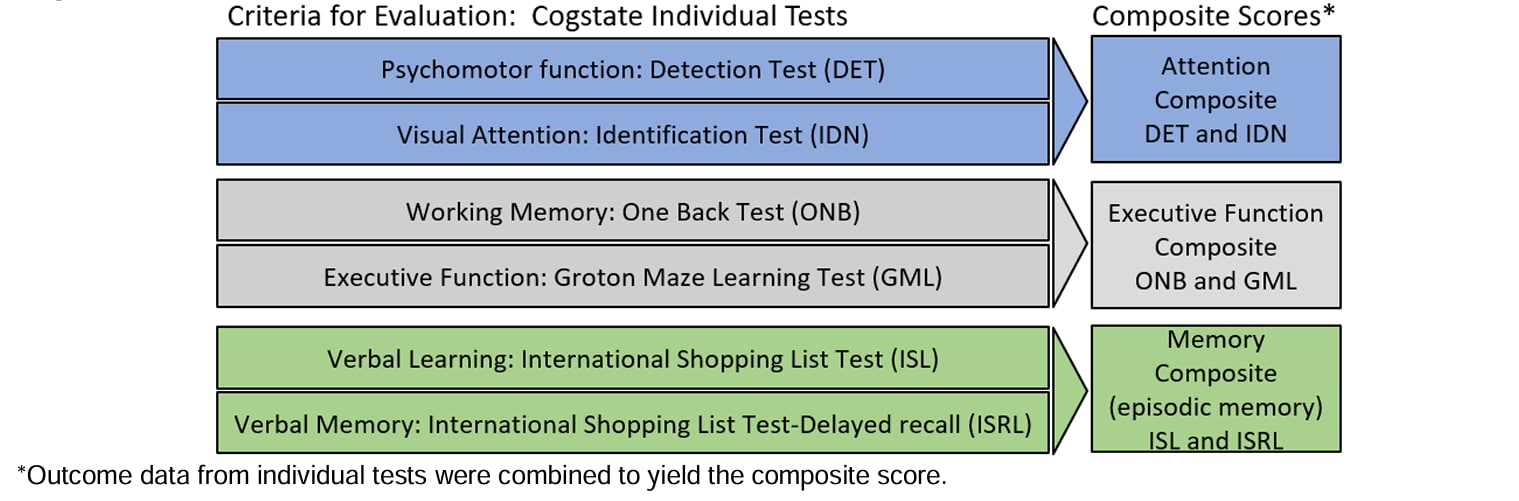
- Cognitive function was assessed prospectively using computerized cognitive tests (COGSTATE) questionnaires (Figure: COGSTATE Individual Tests and Composite Scores), with changes from baseline assessed at each 12-week period. Effect sizes of ≥0.5 in magnitude was considered to be clinically meaningful.
- Additionally, outcomes data from individual tests were combined to yield the following composite scores: attention composite score, executive function composite score, and memory composite score (episodic memory).
- Other endpoints included the percentage of patients with PSA50, PFS, overall survival (OS), and safety.
Figure. COGSTATE Individual Tests and Composite Scores2
Results
Patient Characteristics
- A total of 250 patients were randomized in the study (darolutamide/enzalutamide, n=126; enzalutamide/darolutamide, n=124; intent-to-treat [ITT] population). Of these, 1 patient did not receive treatment due to investigator intervention; 249 received the first treatment (darolutamide/enzalutamide, n=126; enzalutamide/darolutamide, n=123; safety population), and 211 patients received both treatments (darolutamide/enzalutamide, n=106; enzalutamide/darolutamide, n=105; modified intent-to-treat [mITT] population). Baseline characteristics for the 249 patients who received treatment are described in Table: Baseline Characteristics.
Table. Baseline Characteristics2
| Characteristic | Darolutamide/ Enzalutamide (n=126) | Enzalutamide/ Darolutamide (n=123) | Total (N=249) |
| Median age at randomization (IQR), years | 72 (67-80) | 72 (68-79) | 72 (68-79) |
| ECOG PS, n (%) | |||
| 0 | 69 (55) | 70 (57) | 139 (56) |
| 1-2 | 57 (45) | 53 (43) | 110 (44) |
| Prior treatment with taxanes, n (%) | 27 (21) | 27 (22) | 54 (22) |
| Gleason score at diagnosis ≥8, n (%) | 58 (46) | 57 (46) | 115 (46) |
| Metastatic at diagnosis, n (%) | 56 (45) | 50 (41) | 106 (43) |
| Median serum PSA at baseline (IQR), ng/mL | 17 (6-50) | 20 (7-42) | 19 (7-47) |
| Key: ECOG PS, Eastern Cooperative Oncology Group performance status; IQR, interquartile range; PSA, prostate-specific antigen. | |||
Table was adapted from Table. 1 in Colomba E, Jonas SF, Eymard JC, et al. A Randomized, Open-label, Cross-over Phase 2 Trial of Darolutamide and Enzalutamide in Men with Asymptomatic or Mildly Symptomatic Metastatic Castrate-resistant Prostate Cancer: Patient Preference and Cognitive Function in ODENZA. Eur Urol. 2024;85(3):274-282. PMID: 37271630 https://www.ncbi.nlm.nih.gov/pubmed/37271630 [downloaded 08 May 2026] Copyrights remain with the original source or as denoted therein.
Cognitive Assessments
- Cognitive data were available for 193 patients and 191 patients from the first and second periods, respectively. Results are summarized in Table: Summary of Results for Each Individual Cognitive Test and Composite Score Across Overall Assessment Period.
- Performance on the verbal learning test was significantly better with darolutamide than with enzalutamide at each post-baseline assessment, within both periods, and when averaged over periods (averaged effect size, 0.5 [95% CI, 0.3-0.8]). No period effect was reported.
- Performance on the verbal memory test showed differences between darolutamide and enzalutamide in the second period and overall, but these were not clinically meaningful (averaged effect size, 0.3 [95% CI, 0.1-0.5]). No period effect was reported.
- The memory composite score was significant in both periods and overall (averaged effect score, 0.5 [95% CI, 0.3-0.8]). Performances were better in the first period than in the second period when averaged over the treatment conditions. A moderate benefit in episodic memory from darolutamide was observed both for the acquisition of new information and for the recall of that information after a brief delay.
Table. Summary of Results for Each Individual Cognitive Test and Composite Score Across Overall Assessment Period2
| LS Means Difference (Darolutamide vs Enzalutamide) | P-value | Effect Size | |
| Attention composite | 0.1 | 0.2 | 0.2 |
| Psychomotor function: Detection Test | 0.02 | 0.1 | 0.2 |
| Visual attention: Identification Test | 0.01 | 0.6 | 0.1 |
| Executive function composite | 0.1 | 0.2 | 0.2 |
| Working memory: One Back Test | 0 | 0.7 | -0.06 |
| Executive function: Groton Maze Learning Test | 7 | 0.1 | 0.2 |
| Memory composite | 0.4 | <0.001 | 0.5 |
| Verbal learning: International Shopping List Test | 2.2 | <0.001 | 0.5 |
| Verbal memory: International Shopping List Test Delayed Recall | 0.7 | <0.01 | 0.3 |
| Key: LS, least squares. | |||
Table was adapted from Table. 3 in Colomba E, Jonas SF, Eymard JC, et al. A Randomized, Open-label, Cross-over Phase 2 Trial of Darolutamide and Enzalutamide in Men with Asymptomatic or Mildly Symptomatic Metastatic Castrate-resistant Prostate Cancer: Patient Preference and Cognitive Function in ODENZA. Eur Urol. 2024;85(3):274-282. PMID: 37271630 https://www.ncbi.nlm.nih.gov/pubmed/37271630 [downloaded 08 May 2026] Copyrights remain with the original source or as denoted therein.
Safety
- A total of 329 AEs (darolutamide, n=170; enzalutamide, n=159) were reported during the first period. The most common any-grade AEs for darolutamide and enzalutamide were fatigue (49.1% and 58.7%), hot flashes (26.4% and 12.0%), and arthralgia (11.3% and 10.7%). During the second period, similar findings were reported for fatigue and hot flashes.
- Grade 3 AE rates for darolutamide vs enzalutamide, respectively, were 4% vs 6% in phase 1 and 4% vs 7% in phase 2. Grade 4 AEs were reported for 1 patient who received enzalutamide during the first period (hypertension), and 1 patient who received darolutamide during the second period (adult respiratory distress syndrome).
- Fifteen patients (darolutamide, n=8; enzalutamide, n=7) experienced a fall during the first period.
- Two patients discontinued enzalutamide due to AEs in period 1.
LITERATURE SEARCH
A literature search of Embase®, PubMed, and/or other resources, including internal/external databases, was conducted pertaining to this topic on 27 May 2026. Included in this response are clinical studies evaluating the cognitive impact of darolutamide in patients with prostate cancer compared to other therapies. Indirect comparison data are excluded.
REFERENCES
All the references were accessed on the abovementioned literature search date.
- Morgans A, Bobek O, Kwon D, et al. Cognitive Effects of Darolutamide vs Enzalutamide – Results of ARACOG (AFT-47) a Randomized Clinical Trial from the Alliance for Clinical Trials in Oncology. Oral Presentation presented at: American Society of Clinical Oncology (ASCO) Annual Meeting; May 29 – June 2, 2026; Chicago, IL.
- Colomba E, Jonas SF, Eymard JC, et al. A Randomized, Open-label, Cross-over Phase 2 Trial of Darolutamide and Enzalutamide in Men with Asymptomatic or Mildly Symptomatic Metastatic Castrate-resistant Prostate Cancer: Patient Preference and Cognitive Function in ODENZA. Eur Urol. 2024;85(3):274–282. PMID: 37271630 https://www.ncbi.nlm.nih.gov/pubmed/37271630
- Banna G, Maniam A, Rescigno P, et al. ARTA-ATTACK study: assessment of sarcopenia, frailty, and neurocognitive impairment in patients with prostate cancer treated with androgen receptor-targeted agents: a prospective multicenter observational cohort study. Oncologist. Conference Abstract. 2025;30:S11. Accessed via http://dx.doi.org/10.1093/oncolo/oyaf248.029
- NCT07181122. Prospective Observational Evaluation of Quality of Life, Functional Status, and Cognitive Outcomes in Patients With Metastatic Hormone-Sensitive Prostate Cancer Undergoing Androgen Receptor Pathway Inhibitor Therapy. Updated 2026–04–28. Accessed via https://clinicaltrials.gov/study/NCT07181122
- NCT04335682. A Randomized Phase II Study of Androgen Receptor Directed Therapy on COGnitive Function in Patients Treated With Darolutamide or Enzalutamide (ARACOG). Active, not recruiting, Alliance Foundation Trials, LLC. Updated 2025–11–04. Accessed via https://clinicaltrials.gov/study/NCT04335682
- Morgans A, Bobek O, Kwon D, et al. Cognitive effects of darolutamide vs enzalutamide: Results of ARACOG (AFT-47), a randomized clinical trial from the Alliance for Clinical Trials in Oncology. J Clin Oncol; 2026;44:suppl 16; abstr 5005. Accessed via https://www.doi.org/10.1200/JCO.2026.44.16_suppl.5005
- Supplement to: Colomba E, Jonas SF, Eymard JC, et al. A Randomized, Open-label, Cross-over Phase 2 Trial of Darolutamide and Enzalutamide in Men with Asymptomatic or Mildly Symptomatic Metastatic Castrate-resistant Prostate Cancer: Patient Preference and Cognitive Function in ODENZA. Eur Urol. 2024;85(3):274–282. PMID: 37271630 https://www.ncbi.nlm.nih.gov/pubmed/37271630


Follow Us