Nubeqa® Darolutamide
ARASEC Study
SUMMARY
The ARASEC study is a United States (US), prospective, open-label phase 2 study of patients with metastatic hormone-sensitive prostate cancer (mHSPC) treated with darolutamide 600 mg twice daily + androgen-deprivation therapy (ADT) compared to an external control arm of patients treated with ADT alone in the CHAARTED study.1 Patients from the ARASEC and CHAARTED studies were matched 1:1 using propensity scores (n=160 in each group).
At a median follow-up of 26.2 months in the darolutamide + ADT group and 28.3 months in the ADT alone group, median progression-free survival (PFS), median overall survival (OS), median time to metastatic castration-resistant prostate cancer (mCRPC), and median radiographic PFS (rPFS) were significantly improved with darolutamide + ADT vs ADT alone (HR range, 0.26-0.50; all P≤0.003).
A lower proportion of patients in the darolutamide + ADT group vs ADT alone received ≥1 life-prolonging therapy (26.2% vs 64.5%).
Among patients with baseline prostate-specific antigen (PSA) ≥0.2 ng/mL, a higher proportion of patients achieved PSA <0.2 ng/mL with darolutamide + ADT vs ADT alone at 3 months (46% vs 11%), and continued to be higher at 6 months, 12 months, and any time (range, 59%-68% vs 23%-33%).
Results of sensitivity analyses addressing potential time bias, using a contemporary phase 3 cohort, and selection bias, using all enrolled patients, were consistent with the primary ARASEC findings.
In match-eligible patients treated with darolutamide + ADT (n=223), any grade treatment emergent adverse events (TEAEs) were reported in 96.0% (grade 3, 34.5%; grade 4, 1.3%; grade 5, 2.2% [no grade 5 events were treatment-related]). Serious TEAEs were reported in 23.3%, and 8.1% discontinued treatment due to TEAEs. Safety data was not recorded in detail in the CHAARTED ADT arm.
This page is intended for US healthcare professionals and may contain information outside of the approved prescribing information. It is provided in response to an unsolicited request. It is not intended as an endorsement of any usage not contained in the Prescribing Information. This response should be reviewed together with the current full Prescribing Information (including Boxed Warning) and Medical Safety Summary. These materials contain the approved indications, contraindications, warnings and precautions, adverse reactions, and other important safety information for Nubeqa® Darolutamide.
Nubeqa is an androgen receptor inhibitor indicated for the treatment of adult patients with non-metastatic castration-resistant prostate cancer (nmCRPC), metastatic castration-sensitive prostate cancer (mCSPC), and metastatic castration-sensitive prostate cancer (mCSPC) in combination with docetaxel.
CLINICAL DATA
ARASEC Study
McKay, et al (2026)1 presented results from the phase 2 ARASEC study, which assessed the combination of darolutamide + ADT with ADT alone in patients with mHSPC.
Study Design/Methods
ARASEC (NCT05059236) is a US, prospective, open-label phase 2 study with an external control arm from the CHAARTED study (NCT00309985) (Figure: Study Design). As combination therapy was recommended as standard of care for mHSPC in the US when ARASEC was initiated, an ADT alone control arm was not possible.
- Inclusion and exclusion criteria, and the schedule of assessments aligned with those of the CHAARTED study.
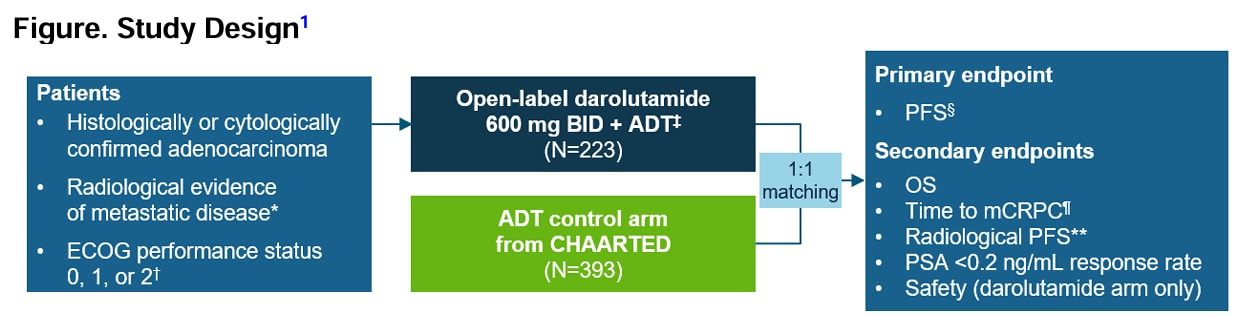
Key: ADT, androgen deprivation therapy; BID, twice daily; ECOG, Eastern Cooperative Oncology Group; mCRPC, metastatic castration-resistant prostate cancer; OS, overall survival; PCWG3, Prostate Cancer Working Group 3; PFS, progression-free survival; PSA, prostate-specific antigen; RECIST, Response Evaluation Criteria in Solid Tumors.
*Metastatic prostate cancer documented by positive bone scan or metastatic lesions on computed tomography or magnetic resonance imaging (per investigator’s discretion).
†Participants with ECOG performance status 2 were eligible only if the decline in performance status was due to metastatic prostate cancer.
‡ADT (with or without first-generation antiandrogen) started no earlier than 120 days before enrollment.
§PFS is defined as PSA progression OR clinical progression (increasing symptomatic bone metastases or radiological progression [RECIST v1.1 for soft tissue metastases and PCWG3 criteria for bone metastases] or clinical deterioration due to cancer per investigator's opinion) OR death.
¶mCRPC is defined as for PFS without the death component.
**Imaging assessments in ARASEC were performed as described in CHAARTED; regular imaging was not mandatory, with assessments in both arms according to local standard of care.
Figure was presented as Fig. on slide 4 in McKay R, Ross AE, Preston MA, et al. Darolutamide plus ADT in mHSPC: ARASEC US prospective, open-label phase 2 study with an external control arm. Oral Presentation presented at: American Urological Association (AUA) Annual Meeting; May, 15-18, 2026; Washington, DC. [downloaded 18 May 2026] Copyrights remain with the original source or as denoted therein.
Results
Patient Characteristics
- A total of 220 patients in the ARASEC study and 392 patients in the CHAARTED study were matched 1:1 using propensity scores (n=160 in each group).
- Propensity score matching was based on age, ECOG performance status, extent of disease, prior local therapy, Gleason score, and baseline PSA level.
- Baseline characteristics of matched patients in both treatment groups are presented in Table: Baseline Characteristics.
Table. Baseline Characteristics1
Characteristics | Darolutamide + ADT (n=160) | ADT alone (CHAARTED) (n=160) | |||
Age, median (range), years | 71 (45-91) | 69 (39-90) | |||
Age category, % | |||||
<68 years | 40.0 | 39.4 | |||
≥68 years | 60.0 | 60.6 | |||
ECOG performance status, % | |||||
0 | 81.9 | 80.6 | |||
1 | 15.6 | 19.4 | |||
2 | 2.5 | 0 | |||
Gleason score at initial diagnosisa , % | |||||
<8 | 28.1 | 30.7 | |||
≥8 | 67.5 | 65.0 | |||
PSA, median (range), ng/mL | 6.0 (0-7978) | 9.8 (0-4071) | |||
PSA category, % | |||||
≤10 ng/mL | 62.5 | 50.0 | |||
>10 ng/mL | 37.5 | 50.0 | |||
Characteristics | Darolutamide + ADT (n=160) | ADT alone (CHAARTED) (n=160) | |||
Extent of disease, % | |||||
High volume with visceral metastases | 23.1 | 20.6 | |||
High volume without visceral metastases | 37.5 | 36.3 | |||
Low volume | 39.4 | 43.1 | |||
Prior local therapyb , % | |||||
No (de novo mHSPC) | 73.8 | 70.0 | |||
Yes (recurrent mHSPC) | 23.6 | 30.0 | |||
Key: ADT, androgen deprivation therapy; ECOG, Eastern Cooperative Oncology Group; mHSPC, metastatic hormone-sensitive prostate cancer. aGleason score at initial diagnosis was unknown in 4.4% of patients in both treatment groups. bPrior therapy is being used as a proxy for de novo vs recurrent (metachronous) mHSPC. | |||||
Table was adapted from Table. Baseline characteristics in McKay R, Ross AE, Preston MA, et al. Darolutamide plus ADT in mHSPC: ARASEC US prospective, open-label phase 2 study with an external control arm. Oral Presentation presented at:
American Urological Association (AUA) Annual Meeting; May, 15-18, 2026; Washington, DC. [downloaded 18 May 2026] Copyrights remain with the original source or as denoted therein.
Efficacy
- Median follow-up was 26.2 months in the darolutamide + ADT group, and 28.3 months in the ADT alone group.
- Median PFS, median OS, median time to mCRPC, and median rPFS were significantly improved with darolutamide + ADT vs ADT alone (Table: Efficacy Outcomes).
Table. Efficacy Outcomes1
| Darolutamide + ADT (n=160) | ADT alone (CHAARTED) (n=160) | ||||
PFS, median, months | NE | 14.3 | |||
HR (95% CI) | 0.29 (0.20-0.40); P<0.001 | ||||
OS, median, months | NE | NE | |||
HR (95% CI) | 0.50 (0.30-0.82); P=0.003 | ||||
24-month OS rate, % | 89% | 80% | |||
Time to mCRPC, median, months | NE | 14.3 | |||
HR (95% CI) | 0.26 (0.18-0.38); P<0.001 | ||||
rPFS, median, months | NE | 29.0 | |||
HR (95% CI) | 0.30 (0.19-0.48); P<0.001 | ||||
Key: ADT, androgen deprivation therapy; CI, confidence interval; HR, hazard ratio; mCRPC, metastatic castration-resistant prostate cancer; NE, not estimable/evaluable; OS, overall survival; PFS, progression-free survival; rPFS, radiographic progression-free survival. | |||||
- After progression to mCRPC, at least 1 life-prolonging therapy was administered to 26.2% of patients in the darolutamide + ADT group and to 64.5% of patients in the ADT alone group. Therapies included abiraterone and/or enzalutamide (11.9% and 38.2%), docetaxel (16.7% and 44.5%), cabazitaxel (0 and 12.7%), and sipuleucel-T (9.5% and 9.1%).
- Among patients with baseline PSA ≥0.2 ng/mL (darolutamide + ADT, n=150; ADT alone, n=146), a higher proportion of patients achieved PSA <0.2 ng/mL with darolutamide + ADT vs ADT alone at 3 months (46% vs 11%), and continued to be higher at 6 months, 12 months, and any time (range, 59%-68% vs 23%-33%).
Sensitivity Analyses
- Sensitivity analyses to address potential time bias as well as matching method were conducted. Based on the methodology, the number of patients included in the analyses are shown below (Table: Patients Included in Sensitivity Analyses).
Table. Patients Included in Sensitivity Analyses1
| Sensitivity analysis method | ARASEC: Darolutamide + ADT | CHAARTED: ADT | ARANOTE: ADT | ||
ARASEC vs ARANOTE | Propensity score matching | n=127 | - | n=127 | |
ARASEC vs CHAARTED | IPTW | n=220a | n=392b | - | |
Key: ADT, androgen deprivation therapy; IPTW, inverse probability of treatment weighting; PSA, prostate-specific antigen. aTwo patients in ARASEC were excluded from matching due to missing extent of disease and one patient due to missing extent of disease and PSA. bOne patient in CHAARTED was excluded from matching due to missing prior local therapy and PSA. | |||||
- Results of sensitivity analyses addressing potential time bias and selection bias are presented below (Figure: Sensitivity Analyses). Time bias was assessed using propensity score matching to compare ARASEC darolutamide + ADT with ADT alone from the more contemporary ARANOTE study (NCT04736199). Selection bias was assessed using inverse probability of treatment weighting (IPTW) in all enrolled patients to adjust for baseline differences between the ARASEC darolutamide + ADT with CHAARTED ADT alone arms.
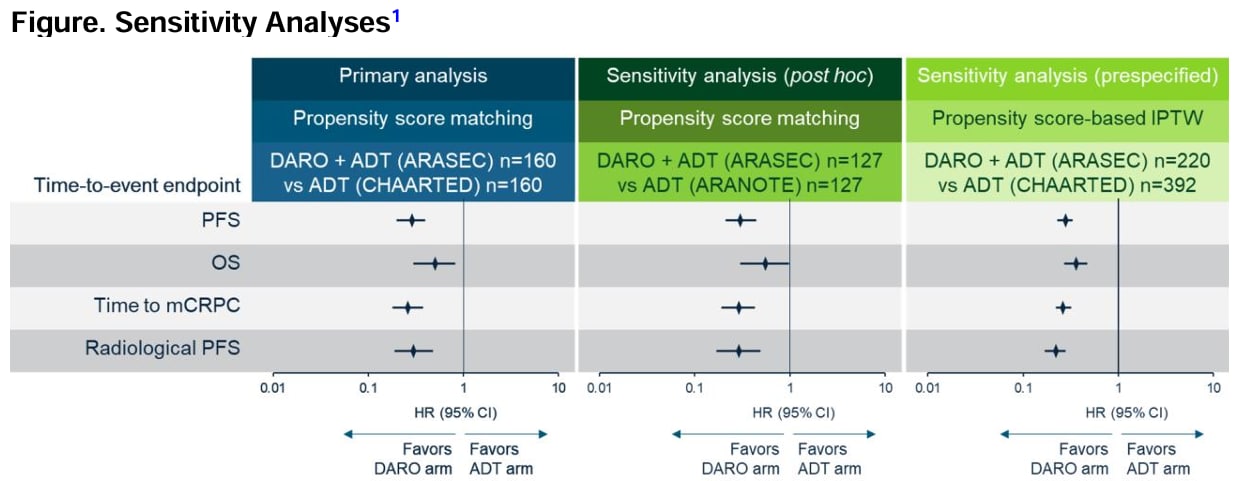
Key: ADT, androgen deprivation therapy; CI, confidence interval; DARO, darolutamide; HR, hazard ratio; IPTW, inverse probability of treatment weighting; mCRPC, metastatic castration-resistant prostate cancer; OS, overall survival; PFS, progression-free survival.
Figure was published as Fig. on slide 17 in McKay R, Ross AE, Preston MA, et al. Darolutamide plus ADT in mHSPC: ARASEC US prospective, open-label phase 2 study with an external control arm. Oral Presentation presented at: American Urological Association (AUA) Annual Meeting; May, 15-18, 2026; Washington, DC. [downloaded 18 May 2026] Copyrights remain with the original source or as denoted therein.
Safety
- Safety outcomes in the ARASEC match-eligible population are presented in Table: Safety Outcomes. Safety data was not recorded in detail in the CHAARTED ADT arm.
Table. Safety Outcomes1
TEAEs, % | Darolutamide + ADT ARASEC Match-eligible Population (n=223) | ||||
Any grade | 96.0 | ||||
Worst severity | |||||
Grade 1 | 16.6 | ||||
Grade 2 | 41.3 | ||||
Grade 3 | 34.5 | ||||
Grade 4 | 1.3 | ||||
Grade 5a | 2.2 | ||||
Serious | 23.3 | ||||
Leading to treatment discontinuation | 8.1 | ||||
Key: ADT, androgen-deprivation therapy; TEAE, treatment-emergent adverse events. aNo grade 5 events were treatment-related. | |||||
Table was adapted from Table. TEAEs in McKay R, Ross AE, Preston MA, et al. Darolutamide plus ADT in mHSPC: ARASEC US prospective, open-label phase 2 study with an external control arm. Oral Presentation presented at: American Urological Association (AUA) Annual Meeting; May, 15-18, 2026; Washington, DC. [downloaded 18 May 2026] Copyrights remain with the original source or as denoted therein.
LITERATURE SEARCH
A literature search of Embase® , PubMed, and/or other resources, including internal/external databases, was conducted pertaining to this topic on 19 May 2026.
REFERENCES
All the references were accessed on the abovementioned literature search date.
- McKay R, Ross AE, Preston MA, et al. Darolutamide plus ADT in mHSPC: ARASEC US prospective, open-label phase 2 study with an external control arm. Oral Presentation presented at: American Urological Association (AUA) Annual Meeting; May, 15-18, 2026; Washington, DC.


Follow Us