Darolutamide
Incidence of Fatigue
SUMMARY
In the phase 3, randomized, double-blind (DB), placebo-controlled studies of darolutamide (ARAMIS, ARASENS, and ARANOTE), incidences of fatigue were reported.1-4 Any grade and exposure-adjusted incidence rates (EAIRs) of fatigue are presented in Table: Fatigue in ARAMIS (DB Period), ARASENS, and ARANOTE.2,4,5
Table. Fatigue in ARAMIS (DB Period), ARASENS, and ARANOTE2,4,5
| Event | ARAMISa | ARASENSb | ARANOTEc | |||||||||
|---|---|---|---|---|---|---|---|---|---|---|---|---|
| DARO + ADT (n=954) | PBO + ADT (n=554) | DARO + ADT + DOCE (n=652)d | PBO + ADT + DOCE (n=650)d | DARO + ADT (n=445) | PBO + ADT (n=221) | |||||||
| Any Gr, % | EAIRe | Any Gr, % | EAIRe | Any Gr, % | EAIRe | Any Gr, % | EAIRe | Any Gr, % | EAIRe | Any Gr, % | EAIRe | |
| Fatigue | 13.2 | 8.3 | 8.3 | 7.4 | 33.1 | 12.5 | 32.9 | 17.8 | 5.6 | 3.2 | 8.1 | 5.7 |
Key: ADT, androgen-deprivation therapy; DARO, darolutamide; DB, double-blind; DOCE, docetaxel; EAIR, exposure-adjusted incidence rate; Gr, grade; mHSPC; metastatic hormone-sensitive prostate cancer; nmCRPC, nonmetastatic castration-resistant prostate cancer; PBO, placebo. aARAMIS evaluated darolutamide + ADT vs placebo + ADT in patients nmCRPC bARASENS evaluated darolutamide + ADT + docetaxel vs placebo + ADT + docetaxel in patients with mHSPC. cARANOTE evaluated darolutamide + ADT vs placebo + ADT in patients with mHSPC. dThree randomized patients were never treated; all 3 were in the placebo group. One patient was randomized in the placebo group but received darolutamide. eEAIR per 100 patient-years. | ||||||||||||
This page is intended for US healthcare professionals and may contain information outside of the approved prescribing information. It is provided in response to an unsolicited request. It is not intended as an endorsement of any usage not contained in the Prescribing Information. This response should be reviewed together with the current full Prescribing Information (including Boxed Warning) and Medical Safety Summary. These materials contain the approved indications, contraindications, warnings and precautions, adverse reactions, and other important safety information for Nubeqa® (Darolutamide)
Nubeqa is an androgen receptor inhibitor indicated for the treatment of adult patients with non-metastatic castration-resistant prostate cancer (nmCRPC), metastatic castration-sensitive prostate cancer (mCSPC), and metastatic castration-sensitive prostate cancer (mCSPC) in combination with docetaxel.
- Additionally, in ARAMIS:
- The incidence of fatigue in the cross-over group (n=170) during the open-label (OL) period was 4.1% (no grade 3/4 events). 6 The incidence of fatigue in the darolutamide group during the DB + OL periods was 14.3% (EAIR per 100 patient-years [PY], 6.8). 7,8
- In the darolutamide group during the DB period, 1 (0.1%) patient discontinued treatment permanently due to fatigue or gait disturbance.9
- The incidences of fatigue for patients initially randomized to darolutamide during the DB + OL + rollover study (ROS) periods and in placebo patients who crossed to darolutamide during the OL + ROS periods, respectively, were 14.9% (EAIR/100 PY, 5.3) and 9.4% (EAIR/100 PY, 2.6).10
- The highest rate of new fatigue events occurred in month 1 of darolutamide treatment. 11
- The incidence of fatigue during the DB period has been reported in several subanalyses: by prostate-specific antigen doubling time (PSADT; ≤6 months or >6 months),12 by number of comorbidities (≤6 or >6) and concomitant medications (≤10 or >10),13 and by prior local therapy. 14 Additional subanalyses are referenced for your information: in Spanish patients, 15 in Japanese patients,16 and in Black/African American patients.17
Additionally, in ARASENS:
- The incidence of fatigue, including the ROS period, was 34.2% (EAIR/100 PY, 11.8).18
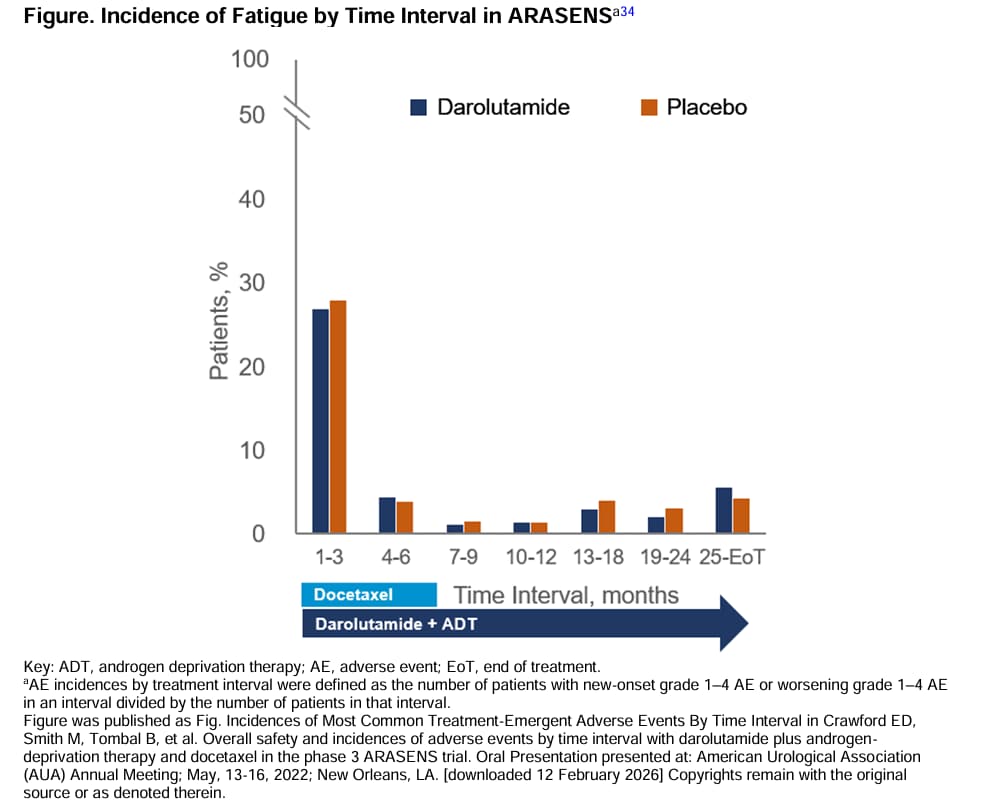
- Fatigue appeared predominantly during the first 3 months of treatment (Table: Incidence of Fatigue by Time Interval in ARASENS).19
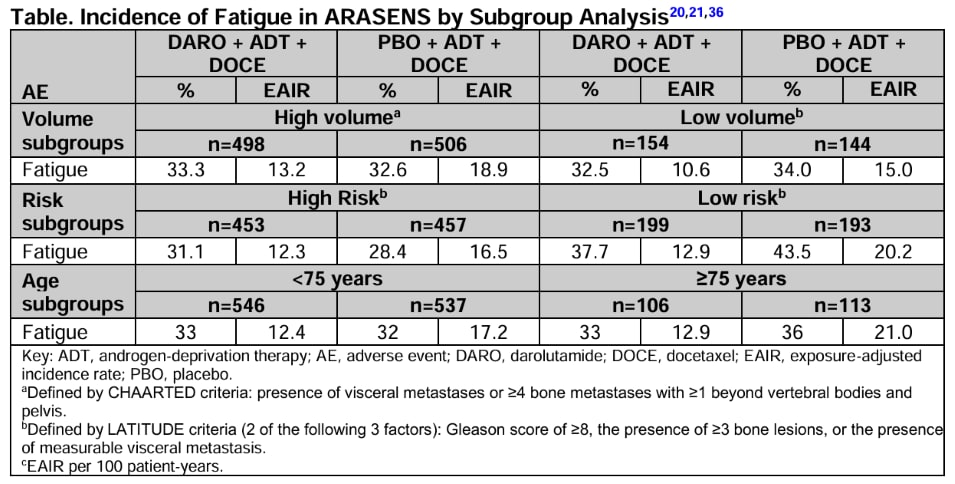
- Subanalyses by disease burden (volume and risk)20 and by age21 reported the incidence of fatigue. Additional subanalyses are referenced for your information: in Black/African American patients, 22 in North American patients,23 in Chinese patients,24 and in European patients. 25
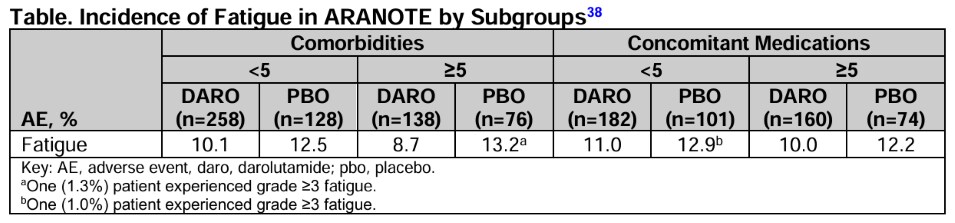
- Additionally, in ARANOTE, the incidence of fatigue has been reported by number of comorbidities (<5 vs ≥5) and concomitant medications (<5 vs ≥5). 26 A subanalysis that reports incidence of fatigue in Black patients is referenced for your information.27
CLINICAL DATA
ARAMIS Study
Fizazi, et al (2019)1 reported the results of the primary analysis of the ARAMIS study (NCT02200614), which evaluated the efficacy and safety of darolutamide + androgendeprivation therapy (ADT) vs placebo + ADT in patients with nonmetastatic castration-resistant prostate cancer (nmCRPC). Subsequently, Fizazi, et al (2020)2 reported the final analysis results.
Study Design/Methods
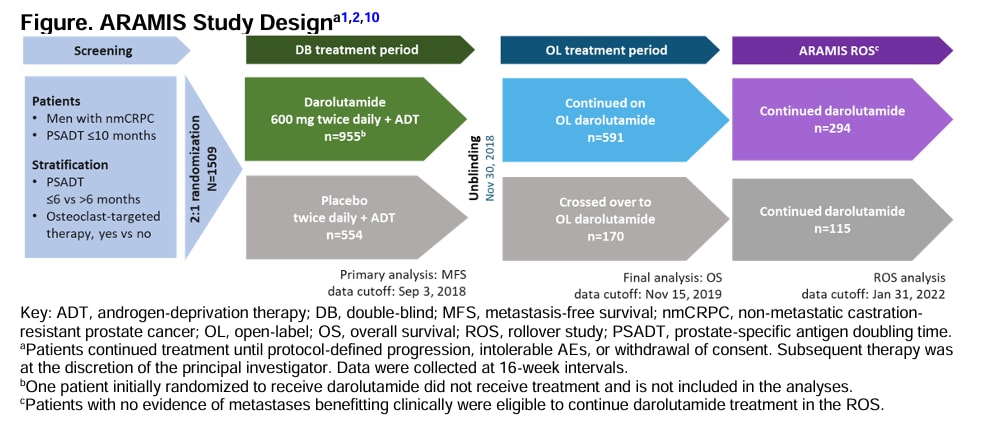
- ARAMIS was a multinational, randomized, DB, placebo-controlled, phase 3 study (Figure: ARAMIS Study Design). 1,2,10
- In the DB period, study treatment could be delayed or reduced in cases of clinically significant toxicity considered related to study treatment (graded according to National Cancer Institute Common Terminology Criteria for Adverse Events [NCI-CTCAE] v4.03).28 Recommended dose modifications and/or delays for toxicities considered related to study treatment can be found below (Table: Dose Modification and/or Delays for Study Drug-Related Toxicities in ARAMIS, ARASENS, and ARANOTE).
Results
Incidence of Fatigue
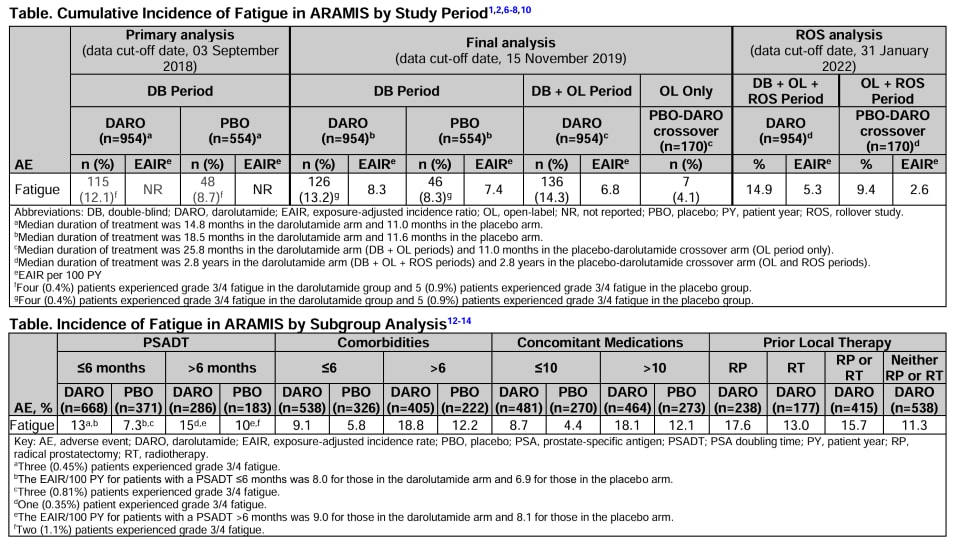
- The cumulative incidence of fatigue throughout the DB, OL, and ROS periods can be found below (Table: Cumulative Incidence of Fatigue in ARAMIS by Study Period).
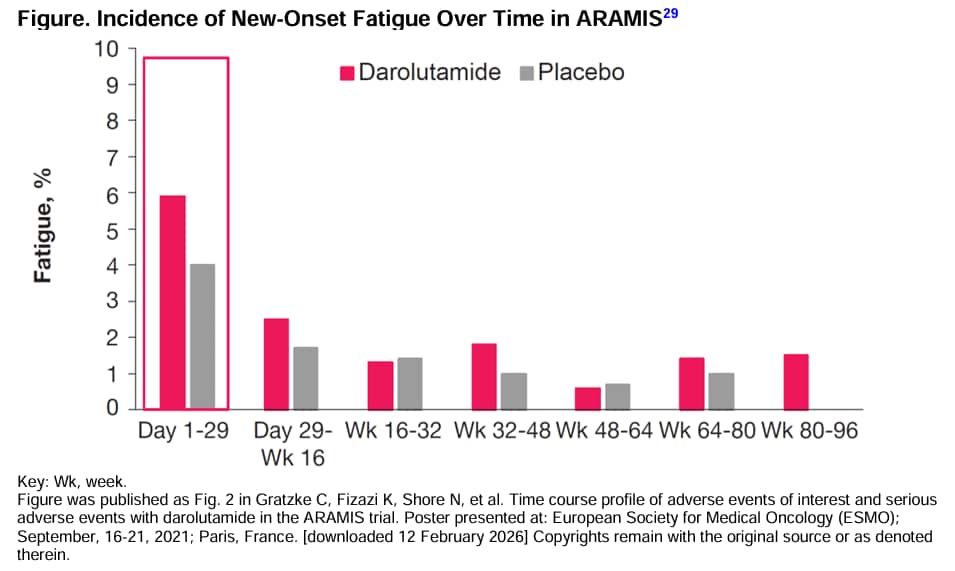
- The highest rate of new fatigue events occurred during the first month of darolutamide treatment.11 In patients who experienced fatigue during the first 24 months of treatment (darolutamide, 12.6%; placebo, 8.3%), almost half (darolutamide, 5.9%; placebo, 4.0%) experienced fatigue during the first month of treatment in both groups. The incidence of new-onset fatigue over time is shown below (Figure: Incidence of New-Onset Fatigue Over Time in ARAMIS). 29
- Drug-related fatigue/gait disturbance that led to permanent discontinuation through the extended follow-up period are presented in Table: Drug-Related Fatigue Leading to Permanent Treatment Discontinuation.
Table. Drug-Related Fatigue Leading to Permanent Treatment Discontinuation9,30
TEAE, n (%) | Darolutamide DB Period (n=954) | Placebo DB Period (n=554) | Darolutamide DB + OL Period (n=954) | Placebo-Darolutamide Crossover (n=170) | |
Fatigue, gait disturbancea | 1 (0.1) | 1 (0.2) | 1 (0.1) | 0 | |
Key: CV, cardiovascular, DB, double-blind; OL, open-label; TEAE, treatment-emergent adverse event. aTEAEs are grouped according to system organ class. | |||||
Table was adapted from Table. S1 in Supplement to: Shore ND, Gratzke C, Feyerabend S, et al. Extended Safety and Tolerability of Darolutamide for Nonmetastatic Castration-Resistant Prostate Cancer and Adverse Event Time Course in ARAMIS. Oncologist. 2024;29(7):581-588. PMID: 38394384 https://www.ncbi.nlm.nih.gov/pubmed/38394384 [downloaded 12 February 2026] Copyrights remain with the original source or as denoted therein.
- The incidence of fatigue stratified by PSADT (≤6 months or >6 months), number of comorbidities (≤6 or >6), number of concomitant medications (≤10 or >10), and prior local therapy (darolutamide arm only; radical prostatectomy [RP], radiotherapy [RT], RP or RT, or neither RP or RT) can be found below (Table: Incidence of Fatigue in ARAMIS by Subgroup Analysis).12-14,31
ARASENS Study
Smith, et al (2022)3 reported results of the primary analysis of the ARASENS study (NCT02799602), which evaluated the efficacy and safety of darolutamide + ADT + docetaxel vs placebo + ADT + docetaxel in patients with metastatic hormone-sensitive prostate cancer (mHSPC).
Study Design/Methods
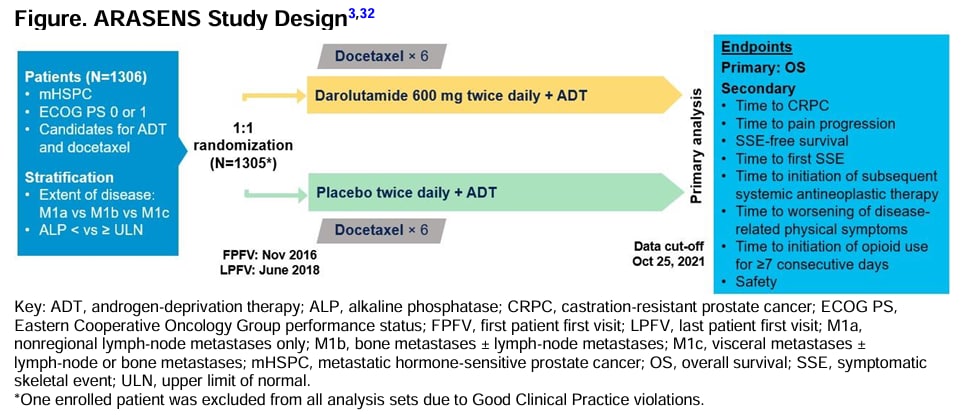
- ARASENS was a phase3, international, randomized, DB, placebo-controlled study (Figure: ARASENS Study Design).
- After completion of the main study, patients who were clinically benefitting from darolutamide treatment, could continue to receive darolutamide and be enrolled in the ARASENS ROS (NCT04464226). 18
- Study treatment could be delayed or reduced in cases of clinically significant toxicity considered related to study treatment (graded according to NCI-CTCAE v4.03).33 Recommended dose modifications and/or delays for toxicities considered related to study treatment can be found below (Table: Dose Modification and/or Delays for Study DrugRelated Toxicities in ARAMIS, ARASENS, and ARANOTE).
Results
- At the data cut-off (25 October 2021), the median treatment duration for the darolutamide arm was 41.0 months, compared to 16.7 months for the placebo arm. 3
Incidence of Fatigue
- The cumulative incidence of fatigue throughout the DB and ROS periods can be found below (Table: Cumulative Incidence of Fatigue in ARASENS by Study Period).
- Fatigue appeared predominantly during the first 3 months of treatment (Figure: Incidence of Fatigue by Time Interval in ARASENS).19,34
- The incidence of fatigue stratified by volume (high vs low), risk (high vs low), and age (<75 vs ≥75 years) is presented below (Table: Incidence of Fatigue in ARASENS by Subgroup Analysis).
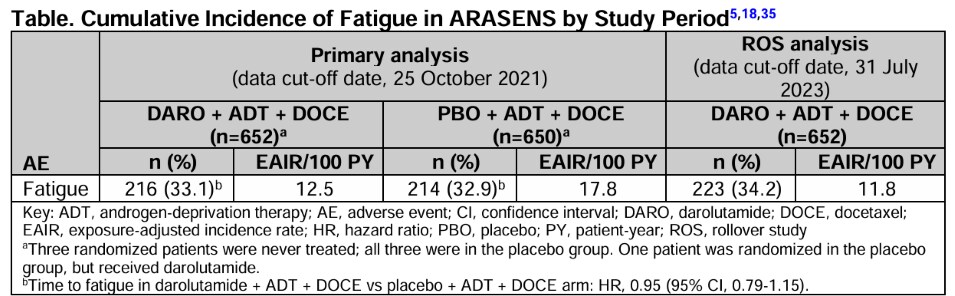
Table was adapted from Table. S5 in Supplement to: Smith MR, Hussain M, Saad F, et al. Darolutamide and Survival in Metastatic, Hormone-Sensitive Prostate Cancer. N Engl J Med. 2022;386(12):1132-1142. Accessed via https://www.nejm.org/doi/suppl/10.1056/NEJMoa2119115/suppl_file/nejmoa2119115_appendix.pdf [downloaded 12 February 2026] Copyrights remain with the original source or as denoted therein.
ARANOTE Study
Saad, et al (2024)4 reported results of the primary analysis of the ARANOTE study, which evaluated the efficacy and safety of darolutamide + ADT vs placebo + ADT in patients with mHSPC.
Study Design/Methods
ARANOTE is a multinational, DB, placebo-controlled phase 3 study (NCT04736199; Figure: ARANOTE Study Design).

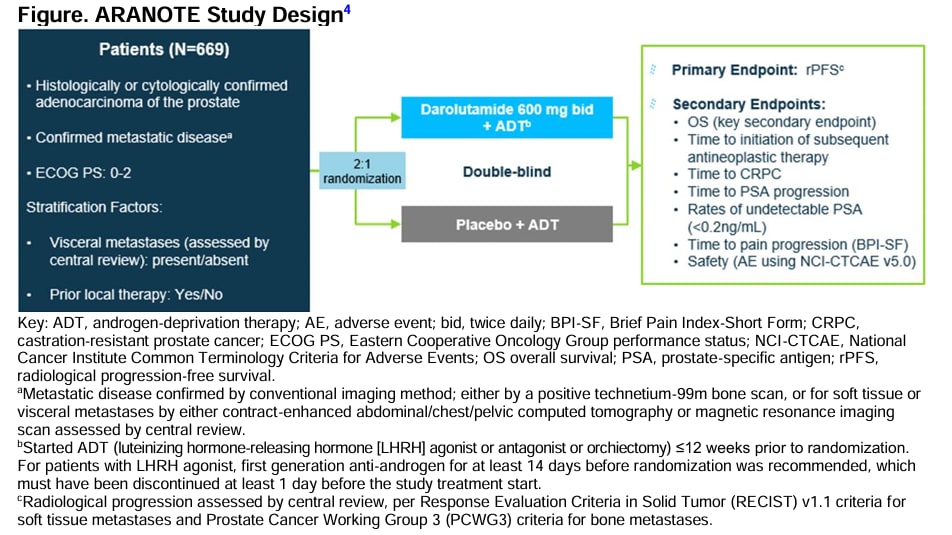
- Study treatment could be delayed or reduced in cases of clinically significant toxicity considered by the investigator as related to study treatment (graded according to NCICTCAE v5.0).37 Recommended dose modifications and/or delays for toxicities considered related to study treatment can be found below (Table: Dose Modification and/or Delays for Study Drug-Related Toxicities in ARAMIS, ARASENS, and ARANOTE).
Results
- At the data of the primary analysis (June 07, 2024), 669 patients were enrolled in the study (darolutamide, n=446; placebo, n=223).4 The safety analysis included 666 patients (darolutamide, n=445; placebo, n=221).
- The median treatment duration for the darolutamide arm was 24.2 months, compared to 17.3 months for the placebo arm..
Incidence of Fatigue
- The incidence and EAIR of fatigue in the darolutamide and placebo groups were:
- Darolutamide: any-grade, 5.6%; grade 3-4, 0; EAIR/100 PY, 3.2.
- Placebo: any-grade, 8.1%; grade 3-4, 0.5%; EAIR/100 PY, 5.7.
- Incidence of fatigue by number of comorbidities and concomitant medications is presented in Table: Incidence of Fatigue in ARANOTE by Subgroups. 26
Management of Fatigue in ARAMIS, ARASENS, and ARANOTE
- Recommended dose modifications and/or delays for toxicities considered related to study treatment in ARAMIS, ARASENS, and ARANOTE can be found below (Table: Dose Modification and/or Delays for Study Drug-Related Toxicities in ARAMIS, ARASENS and ARANOTE).
Table. Dose Modification and/or Delays for Study Drug-Related Toxicities in ARAMIS, ARASENS and ARANOTE 28,33,37
Toxicity Severity Gradea | Dose Modification/Delay | Study Drug Withdrawal | |||
Grade 0-2 |
| - | |||
Grade 3-4 |
|
| |||
aGraded according to National Cancer Institute Common Terminology Criteria for Adverse Events v4.03 for ARAMIS and ARASENS, and v5.0 for ARANOTE. b If there is no recovery after 28 consecutive days, treatment should be permanently discontinued. cDose re-escalation to 600 mg twice daily may be considered at the discretion of the investigator when the adverse event returns to baseline or is resolved. d If the dose is re-escalated to 600 mg and a second grade ≥3 treatment-related adverse event occur, a permanent discontinuation is required. A third occurrence of grade ≥3 treatment-related adverse event requires permanent discontinuation of study treatment. | |||||
LITERATURE SEARCH
A literature search of Embase® , PubMed, and/or other resources, including internal/external databases, was conducted pertaining to this topic on 12 February 2026. Included in this response are relevant data from phase 3 studies. Additional data beyond these parameters are available in the published literature.
REFERENCES
All the references were accessed on the abovementioned literature search date.
- Fizazi K, Shore N, Tammela TL, et al. Darolutamide in Nonmetastatic, CastrationResistant Prostate Cancer. N Engl J Med. 2019;380(13):1235-1246. PMID: 30763142 https://www.ncbi.nlm.nih.gov/pubmed/30763142
- Fizazi K, Shore N, Tammela TL, et al. Nonmetastatic, Castration-Resistant Prostate Cancer and Survival with Darolutamide. N Engl J Med. 2020;383(11):1040-1049. PMID: 32905676 https://www.ncbi.nlm.nih.gov/pubmed/32905676
- Smith MR, Hussain M, Saad F, et al. Darolutamide and Survival in Metastatic, HormoneSensitive Prostate Cancer. N Engl J Med. 2022;386(12):1132-1142. PMID: 35179323 https://www.ncbi.nlm.nih.gov/pubmed/35179323
- Saad F, Vjaters E, Shore N, et al. Darolutamide in Combination With AndrogenDeprivation Therapy in Patients With Metastatic Hormone-Sensitive Prostate Cancer From the Phase III ARANOTE Trial. J Clin Oncol. 2024;42(36):4271-4281. PMID: 39279580 https://pubmed.ncbi.nlm.nih.gov/39279580/
- Supplement to: Smith MR, Hussain M, Saad F, et al. Darolutamide and Survival in Metastatic, Hormone-Sensitive Prostate Cancer. N Engl J Med. 2022;386(12):1132- 1142. Accessed via https://www.nejm.org/doi/suppl/10.1056/NEJMoa2119115/suppl_file/nejmoa2119115_ap pendix.pdf
- Supplement to: Fizazi K, Shore N, Tammela TL, et al. Nonmetastatic, Castration - Resistant Prostate Cancer and Survival with Darolutamide. N Engl J Med. 2020;383(11):1040-1049. PMID: 32905676 https://www.nejm.org/doi/suppl/10.1056/NEJMoa2001342/suppl_file/nejmoa2001342_ap pendix.pdf
- Smith MR, Fizazi K, Tammela T, et al. Safety of darolutamide for nonmetastatic castration-resistant prostate cancer (nmCRPC) from extended follow-up in the phase III ARAMIS trial. Poster presented at: American Society of Clinical Oncology (ASCO) Genitourinary Meeting; February, 11-13, 2021; Virtual Meeting.
- Shore ND, Luz MA, Ulys A, et al. Long-term safety and tolerability of darolutamide and duration of treatment in patients with nonmetastatic castration-resistant prostate cancer (nmCRPC) from the ARAMIS Rollover study. Poster presented at: American Society of Clinical Oncology (ASCO) Genitourinary Cancers Symposium; February, 16-18, 2023; San Francisco, CA.
- Supplement to: Shore ND, Gratzke C, Feyerabend S, et al. Extended Safety and Tolerability of Darolutamide for Nonmetastatic Castration-Resistant Prostate Cancer and Adverse Event Time Course in ARAMIS. Oncologist. 2024;29(7):581-588. PMID: 38394384 https://www.ncbi.nlm.nih.gov/pubmed/38394384
- Bögemann M, Fizazi K, Luz M, et al. Safety, tolerability, and duration of continued darolutamide treatment in patients with nonmetastatic castration-resistant prostate cancer (nmCRPC): ARAMIS Rollover Study (ROS). Oral Presentation presented at: European Association of Urology (EAU) Annual Meeting; March, 10-13, 2023; Milan, Italy.
- Shore ND, Gratzke C, Feyerabend S, et al. Extended Safety and Tolerability of Darolutamide for Nonmetastatic Castration-Resistant Prostate Cancer and Adverse Event Time Course in ARAMIS. Oncologist. 2024;29(7):581-588. PMID: 38394384 https://www.ncbi.nlm.nih.gov/pubmed/38394384
- Bogemann M, Shore ND, Smith MR, et al. Efficacy and Safety of Darolutamide in Patients with Nonmetastatic Castration-resistant Prostate Cancer Stratified by Prostatespecific Antigen Doubling Time: Planned Subgroup Analysis of the Phase 3 ARAMIS Trial. Eur Urol. 2023;83(3):212-221. PMID: 36089 https://pubmed.ncbi.nlm.nih.gov/36089529/
- Fizazi K, Shore ND, Smith M, et al. Efficacy and safety outcomes of darolutamide in patients with non-metastatic castration-resistant prostate cancer with comorbidities and concomitant medications from the randomised phase 3 ARAMIS trial. Eur J Cancer. 2023;192:113258. PMID: 37660438 https://www.ncbi.nlm.nih.gov/pubmed/37660438
- Siemens D, Fizazi K, Shore N, et al. Efficacy and Safety of Darolutamide in Nonmetastatic Castration-resistant Prostate Cancer Patients With and Without Prior Local Therapy With Radical Prostatectomy or Radiotherapy From ARAMIS. Poster presented at: American Urological Association (AUA) Annual Meeting; May 13-16, 2022; New Orleans, LA
- Carles J, Medina-Lopez RA, Puente J, et al. Darolutamide in Spanish patients with nonmetastatic castration-resistant prostate cancer: ARAMIS subgroup analysis. Future Oncol. 2023;19(12):819-828. PMID: 37222151 https://pubmed.ncbi.nlm.nih.gov/37222151/
- Uemura H, Matsushima H, Kobayashi K, et al. Efficacy and safety of darolutamide in Japanese patients with nonmetastatic castration-resistant prostate cancer: a sub-group analysis of the phase III ARAMIS trial. Int J Clin Oncol. 2021;26(3):578-590. PMID: 33226524 https://www.ncbi.nlm.nih.gov/pubmed/33226524
- Shore ND, Cruz F, Nordquist L, et al. Efficacy and safety of darolutamide in Black/African-American patients from the phase III ARAMIS study. Future Oncol. 2022;18(40):4473-4482. PMID: 36753353 https://pubmed.ncbi.nlm.nih.gov/36753353/
- Tombal B, Shore N, Hussain M, et al. Long-term treatment with darolutamide in patients with metastatic hormone-sensitive prostate cancer (mHSPC): ARASENS Rollover Study. Poster presented at: European Multidisciplinary Congress on Urological Cancers (EMUC) Annual Meeting; November, 7-10, 2024; Lisbon, Portugal.
- Fizazi K, Smith MR, Hussain M, et al. Quality of life and patient-relevant endpoints with darolutamide in the phase III ARASENS study. Annals of Oncology. 2022;33(7):S1162- S1162. Accessed via https://www.annalsofoncology.org/article/S0923-7534(22)03343- 9/fulltext
- Hussain M, Tombal B, Saad F, et al. Darolutamide Plus Androgen-Deprivation Therapy and Docetaxel in Metastatic Hormone-Sensitive Prostate Cancer by Disease Volume and Risk Subgroups in the Phase III ARASENS Trial. J Clin Oncol. 2023;41(20):3595- 3607. PMID: 36795843 https://www.ncbi.nlm.nih.gov/pubmed/36795843
- Carles J, Tombal B, Hussain M, et al. Age-related Efficacy and Safety of Darolutamide Plus Androgen-deprivation Therapy and Docetaxel in Patients with Metastatic Hormone-sensitive Prostate Cancer: A Subgroup Analysis of the Phase 3 ARASENS Trial. Eur Urol Oncol. 2025;PMID: 41193271 https://www.ncbi.nlm.nih.gov/pubmed/41193271
- Shore ND, Hussain M, Saad F, et al. Efficacy and Safety of Darolutamide in Combination With Androgen-Deprivation Therapy and Docetaxel in Black Patients From the Randomized ARASENS Trial. Oncologist. 2024;29(3):235-243. PMID: 37812679 https://www.ncbi.nlm.nih.gov/pubmed/37812679
- Shore N, Tombal B, Hussain M, et al. Efficacy and safety of darolutamide in combination with androgen-deprivation therapy and docetaxel in the North American population from ARASENS. Poster presented at: American Urological Association (AUA) Annual Meeting; April 28-May 1, 2023; Chicago, IL.
- Wang S, Fu C, Li Y, et al. Darolutamide in combination with androgen-deprivation therapy and docetaxel in Chinese patients with metastatic hormone-sensitive prostate cancer in the phase 3 ARASENS study. Oral Presentation presented at: European Society for Medical Oncology (ESMO) Asia Congress; December, 1-3, 2023; Singapore, Republic of Singapore.
- Tombal B, Hussain M, Saad F, et al. Efficacy and Safety of Darolutamide in Combination with Androgen-deprivation Therapy and Docetaxel in European Patients From the Phase 3 ARASENS Trial. Poster presented at: European Association of Urology (EAU) Annual Meeting; April 5-8, 2024; Paris, France
- Saad F, Haresh KP, Vjaters E, et al. Efficacy and safety of darolutamide and ADT in patient subgroups by baseline comorbidities and concomitant medications: ARANOTE post hoc analyses. Poster presented at: American Society of Clinical Oncology Genitourinary (ASCO GU) Cancer Symposium; February, 26-28, 2026; San Francisco, CA.
- Trinh Q, George D, Shore N, et al. Efficacy and safety of darolutamide plus androgendeprivation therapy in Black patients with metastatic hormone-sensitive prostate cancer from the phase 3 ARANOTE trial. Poster presented at: American Urological Association (AUA) Annual Meeting; April, 26-29, 2025; Las Vegas, NV.
- Protocol for: Fizazi K, Shore N, Tammela TL, et al. Darolutamide in Nonmetastatic, Castration-Resistant Prostate Cancer. N Engl J Med. 2019;380(13):1235-1246. Accessed via https://www.nejm.org/doi/suppl/10.1056/NEJMoa1815671/suppl_file/nejmoa1815671_pr otocol.pdf
- Gratzke C, Fizazi K, Shore N, et al. Time course profile of adverse events of interest and serious adverse events with darolutamide in the ARAMIS trial. Poster presented at: European Society for Medical Oncology (ESMO); September, 16-21, 2021; Paris, France.
- Fizazi K, Shore N, Smith M, et al. Darolutamide tolerability from extended follow up and treatment response in the phase 3 ARAMIS trial. Poster presented at: American Society of Clinical Oncology (ASCO) annual meeting; June, 4-8, 2021; Virtual Meeting.
- Supplement to: Bogemann M, Shore ND, Smith MR, et al. Efficacy and Safety of Darolutamide in Patients with Nonmetastatic Castration-resistant Prostate Cancer Stratified by Prostate-specific Antigen Doubling Time: Planned Subgroup Analysis of the Phase 3 ARAMIS Trial. Eur Urol. 2023;83(3):212-221. PMID: 36089529 https://www.ncbi.nlm.nih.gov/pubmed/36089529
- Smith M, Hussain M, Saad F, et al. Overall survival with darolutamide versus placebo in combination with androgen-deprivation therapy and docetaxel for metastatic hormone - sensitive prostate cancer in the phase 3 ARASENS trial. Oral Presentation presented at: American Society of Clinical Oncology (ASCO) Genitourinary Cancers Symposium; February 16-18, 2022; San Francisco, CA.
- Protocol for: Smith MR, Hussain M, Saad F, et al. Darolutamide and Survival in Metastatic, Hormone-Sensitive Prostate Cancer. N Engl J Med. 2022;386(12):1132- 1142. Accessed via https://www.nejm.org/doi/suppl/10.1056/NEJMoa2119115/suppl_file/nejmoa2119115_pr otocol.pdf
- Crawford ED, Smith M, Tombal B, et al. Overall safety and incidences of adverse events by time interval with darolutamide plus androgen-deprivation therapy and docetaxel in the phase 3 ARASENS trial. Oral Presentation presented at: American Urological Association (AUA) Annual Meeting; May, 13-16, 2022; New Orleans, LA.
- Fizazi K, Smith MR, Hussain M, et al. Quality of life and patient-relevant endpoints with darolutamide in the phase III ARASENS study. Oral Presentation presented at: European Society for Medical Oncology (ESMO) Congress; September, 9-13, 2022; Paris, France.
- Carles J, Tombal B, Hussain M, et al. Age-related efficacy and safety of darolutamide plus androgen-deprivation therapy (ADT) and docetaxel in patients with metastatic hormone-sensitive prostate cancer (mHSPC): A subgroup analysis of ARASENS. Poster presented at: American Society of Clinical Oncology Genitourinary (ASCO-GU) Annual Meeting; February, 13-15, 2025; San Francisco, CA.
- Protocol to: Saad F, Vjaters E, Shore N, et al. Darolutamide in Combination With Androgen-Deprivation Therapy in Patients With Metastatic Hormone-Sensitive Prostate Cancer From the Phase III ARANOTE Trial. J Clin Oncol. 2024:Jco2401798. Accessed via https://ascopubs.org/action/downloadSupplement?doi=10.1200%2FJCO-24- 01798&file=protocol_JCO-24-01798.pdf
- Supplement to: Saad F, Haresh KP, Vjaters E, et al. Efficacy and safety of darolutamide and ADT in patient subgroups by baseline comorbidities and concomitant medications: ARANOTE post hoc analyses. Poster presented at: American Society of Clinical Oncology Genitourinary (ASCO GU) Cancer Symposium; February, 26-28, 2026; San Francisco, CA.


Follow Us