Nubeqa® (Darolutamide)
Drug Interactions with Direct Oral Anticoagulants (DOACs)
SUMMARY
- In three phase 3 randomized, double-blind, placebo-controlled trials, antithrombotic agents were among the most common concomitant medications administered alongside study medications. No outcomes were reported in either study regarding interactions between darolutamide and DOACs.
- The ARAMIS study evaluated the efficacy and safety of darolutamide vs placebo (both in combination with androgen-deprivation therapy [ADT]) in nonmetastatic, castrationresistant prostate cancer (nmCRPC; N=1509). In the darolutamide (n=955) and placebo (n=554) arms, respectively, 42.8% and 39.7% of patients received concomitant antithrombotic agents.1,2
- The ARASENS study evaluated the efficacy and safety of darolutamide vs placebo (both in combination with ADT and docetaxel) in metastatic hormone-sensitive prostate cancer (mHSPC; N=1305). In the darolutamide (n=651) and placebo (n=654) arms, respectively, 40.2% and 38.4% of patients received concomitant antithrombotic agents.3,4
- The ARANOTE study evaluated the efficacy and safety of darolutamide vs placebo (both in combination with ADT) in mHSPC (N=669). In the darolutamide (n=446) and placebo (n=223) arms, respectively, 17.3% and 13.9% of patients received concomitant antithrombotic agents.5-7
This page is intended for US healthcare professionals and may contain information outside of the approved prescribing information. It is provided in response to an unsolicited request. It is not intended as an endorsement of any usage not contained in the Prescribing Information. This response should be reviewed together with the current full Prescribing Information (including Boxed Warning) and Medical Safety Summary. These materials contain the approved indications, contraindications, warnings and precautions, adverse reactions, and other important safety information for Nubeqa® (Darolutamide).
Nubeqa is an androgen receptor inhibitor indicated for the treatment of adult patients with non-metastatic castration-resistant prostate cancer (nmCRPC), metastatic castration-sensitive prostate cancer (mCSPC), and metastatic castration-sensitive prostate cancer (mCSPC) in combination with docetaxel.
- Based on an exploratory population pharmacokinetic analysis of an ARAMIS subgroup (n=388), no significant effect of comedications, including antithrombotics, was identified on the pharmacokinetics of darolutamide. Based on the effects of darolutamide on the exposure of cytochrome P450 (CYP) enzyme or transporter substrates, no clinically significant drug interactions are expected with known CYP3A4 substrates (eg, rivaroxaban) or P-glycoprotein (P-gp) substrates (eg, dabigatran etexilate).2
- A phase 1 study which assessed the effect of darolutamide on the pharmacokinetics of midazolam and dabigatran etexilate (n=15) found that darolutamide showed no P-gp inhibition potential8:
- Concomitant administration of dabigatran etexilate with darolutamide reduced the area under the curve (AUC) and maximum plasma concentration (Cmax) of non-conjugated dabigatran etexilate by 9% and 16%, respectively.
- Time to maximum plasma concentration (tmax) and half-life (t1/2) values of non-conjugated dabigatran etexilate were similar regardless of darolutamide administration.
- No safety concerns were identified regarding concomitant dabigatran etexilate and darolutamide.
BACKGROUND
Darolutamide is a novel androgen receptor inhibitor primarily metabolized via the mediation of CYP3A4.2,8 In vitro studies have shown that darolutamide does not inhibit any CYP enzymes in a relevant manner. In vivo studies determined that darolutamide weakly induces CYP3A4 only and that, at therapeutic levels, darolutamide does not affect P-gp substrates.
PHARMACOKINETIC DATA
Prespecified and Post-hoc Analyses of ARAMIS
Shore, et al (2019)2 conducted prespecified and post-hoc analyses in patients with nmCRPC from the ARAMIS trial. Analyses included assessments of comorbidities and comedication use, the effects of comedications on the pharmacokinetics of darolutamide, and the impact of coadministering darolutamide with concomitant medications on patient safety.
- In the ARAMIS study, more than a third of patients treated with darolutamide or placebo received antithrombotic medications (42.8% vs 39.7%, respectively).
- The population pharmacokinetic analysis included 40% (n=388) of the total darolutamidetreated patients from ARAMIS. Among these patients, there was no significant association between the pharmacokinetic variability of darolutamide and the use of comedications included in the analysis (CYP3A4 inhibitors, P-gp inhibitors, proton pump inhibitors [PPIs], breast cancer resistance protein [BCRP] inhibitors, UDP glucuronosyltransferase family 1 member A9 [UGT1A9] inhibitors, and CYP3A4 inducers).
- Based on the effects of darolutamide on the exposure of CYP enzyme or transporter substrates, no clinically significant drug interactions are expected with known CYP3A4 substrates (eg, rivaroxaban) or P-gp substrates (eg, dabigatran etexilate).
Interaction with Dabigatran Etexilate
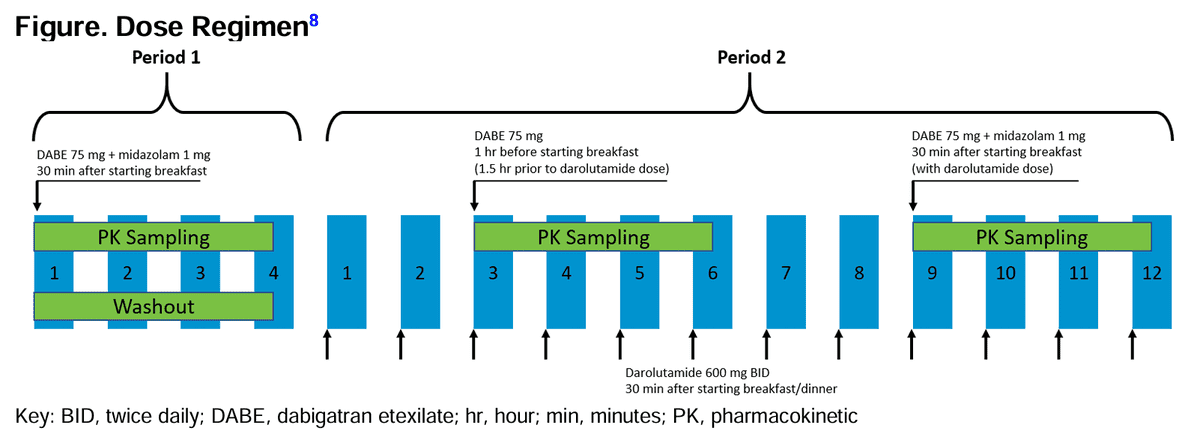
Zurth, et al (2019)8 assessed the effect of darolutamide on the pharmacokinetics of midazolam (CYP3A4 substrate) and dabigatran etexilate (intestinal P-gp substrate) in a phase 1, openlabel, two-period, non-randomized, fixed-sequence study (NCT03237416).
- All subjects (n=15) received darolutamide twice daily. All subjects were healthy male volunteers, with a median age of 57.5 years (range, 49-64 years), median weight of 77.6 kg (range, 62.5-89.0 kg), median height of 174 cm (range, 167-183 cm) and median body mass index (BMI) of 25.6 kg/m2 (range, 21.4-29.9 kg/m2 ).
- The dose regimen for this study is provided below (Figure: Dose Regimen). Pharmacokinetic sampling was conducted on days 1-4 in period 1, and on days 3-6 and 9-12 in period 2. On the first day of pharmacokinetic sampling (period 1, day 1; period 2, days 3 and 9), samples were collected more frequently and included a sample taken prior to drug administration.8,9
- Two subjects were excluded from the pharmacokinetic analysis as they did not have valid pharmacokinetic profiles. All patients (n=15) were considered for the safety analysis.
- Darolutamide showed no P-gp inhibition potential. Concomitant administration of dabigatran etexilate with darolutamide reduced the AUC and Cmax of non-conjugated dabigatran etexilate by 9% and 16%, respectively, while tmax and t1/2 values were similar regardless of darolutamide administration.
- No safety concerns were identified regarding the concomitant administration of dabigatran etexilate and darolutamide.
LITERATURE SEARCH
A literature search of Embase® , PubMed, and/or other resources, including internal/external databases, was conducted pertaining to this topic on 08 May 2026. Summarized in this response are data from prospective studies. Additional data may be available in the published literature.
REFERENCES
All the references were accessed on the abovementioned literature search date.
- Fizazi K, Shore N, Tammela TL, et al. Darolutamide in Nonmetastatic, CastrationResistant Prostate Cancer. N Engl J Med. 2019;380(13):1235-1246. PMID: 30763142 https://www.ncbi.nlm.nih.gov/pubmed/30763142
- Shore N, Zurth C, Fricke R, et al. Evaluation of Clinically Relevant Drug-Drug Interactions and Population Pharmacokinetics of Darolutamide in Patients with Nonmetastatic Castration-Resistant Prostate Cancer: Results of Pre-Specified and Post Hoc Analyses of the Phase III ARAMIS Trial. Target Oncol. 2019;14(5):527-539. PMID: 31571095 https://www.ncbi.nlm.nih.gov/pubmed/31571095
- Smith MR, Hussain M, Saad F, et al. Darolutamide and Survival in Metastatic, Hormone Sensitive Prostate Cancer. N Engl J Med. 2022;386(12):1132-1142. PMID: 35179323 https://www.ncbi.nlm.nih.gov/pubmed/35179323
- Data on File. ARASENS Clinical Study Report Addendum B002104. 04 Oct 2023. Bayer.
- Saad F, Vjaters E, Shore N, et al. Darolutamide in Combination With Androgen Deprivation Therapy in Patients With Metastatic Hormone-Sensitive Prostate Cancer From the Phase III ARANOTE Trial. J Clin Oncol. 2024;42(36):4271-4281. PMID: 39279580 https://pubmed.ncbi.nlm.nih.gov/39279580/
- Saad F, Haresh KP, Vjaters E, et al. Efficacy and safety of darolutamide and ADT in patient subgroups by baseline comorbidities and concomitant medications: ARANOTE post hoc analyses. Poster presented at: American Society of Clinical Oncology Genitourinary (ASCO GU) Cancer Symposium; February, 26-28, 2026; San Francisco, CA.
- Supplement to: Saad F, Haresh KP, Vjaters E, et al. Efficacy and safety of darolutamide and ADT in patient subgroups by baseline comorbidities and concomitant medications: ARANOTE post hoc analyses. Poster presented at: American Society of Clinical Oncology Genitourinary (ASCO GU) Cancer Symposium; February, 26-28, 2026; San Francisco, CA.
- Zurth C, Koskinen M, Fricke R, et al. Drug-Drug Interaction Potential of Darolutamide: In Vitro and Clinical Studies. Eur J Drug Metab Pharmacokinet. 2019;44(6):747-759. PMID: 31571146 https://www.ncbi.nlm.nih.gov/pubmed/31571146
- Supplement to: Zurth C, Koskinen M, Fricke R, et al. Drug-Drug Interaction Potential of Darolutamide: In Vitro and Clinical Studies. Eur J Drug Metab Pharmacokinet. 2019;44(6):747-759. Accessed via https://pubmed.ncbi.nlm.nih.gov/31571146/


Follow Us