Nubeqa® (Darolutamide) Comparison with Enzalutamide in Non-Metastatic Castration-Resistant Prostate Cancer (nmCRPC)
SUMMARY
Darolutamide is a structurally distinct androgen receptor inhibitor (ARI), which has demonstrated low penetration of the blood-brain barrier in preclinical studies, as also supported by neuroimaging studies in healthy humans.1,2
While no prospective, randomized, head-to-head clinical trials have been conducted to compare the efficacy and safety of darolutamide and enzalutamide, several other types of studies have been conducted. 3-6
In a 2021 matching-adjusted indirect comparison (MAIC) study, after adjusting for study differences and multiple testing, darolutamide showed a generally favorable safety profile compared to enzalutamide, with a statistically significantly lower risk of falls, dizziness, mental impairment, fatigue (all grades), and severe fatigue than enzalutamide (all P<0.05).3
An observational retrospective cohort study (ARASHI) evaluated real-world utilization and outcomes of darolutamide, apalutamide, and enzalutamide in patients with nmCRPC in Japan (N=2746).4 In patients treated with darolutamide (n=418) and enzalutamide (n=1898), respectively:
Median time to ARI discontinuation was 16.1 and 12.3 months (hazard ratio [HR], 0.81 [95% confidence interval (CI), 0.78-0.85]).
Median time to metastatic castration-resistant prostate cancer (mCRPC) was not reached (NR) and NR (HR, 0.66 [95% CI, 0.61-0.72]).
An observational retrospective cohort study (DEAR) evaluated the real-world use and outcomes of darolutamide, enzalutamide, and apalutamide in patients with nmCRPC (N=870).5
A lower proportion of patients in the darolutamide group had the composite end point of ARI discontinuation or progression to mCRPC compared with enzalutamide (37.0% vs 52.6%). When adjusted for baseline covariates, darolutamide-treated patients had a reduced risk compared with enzalutamide for:
Composite endpoint of ARI discontinuation or progression: 33.8% (adjusted HR, 0.66 [95% CI, 0.53-0.84])
ARI discontinuation: 27.4% (HR, 0.73 [95% CI, 0.56-0.94])
Progression to mCRPC: 40.6% (HR, 0.59 [95% CI, 0.43-0.82])
A lower proportion of patients in the darolutamide group had AEs compared with the enzalutamide group (24.9% vs 29.3%).
This page is intended for US healthcare professionals and may contain information outside of the approved prescribing information. It is provided in response to an unsolicited request. It is not intended as an endorsement of any usage not contained in the Prescribing Information. This response should be reviewed together with the current full Prescribing Information (including Boxed Warning) and Medical Safety Summary. These materials contain the approved indications, contraindications, warnings and precautions, adverse reactions, and other important safety information for Nubeqa® (Darolutamide).
Nubeqa is an androgen receptor inhibitor indicated for the treatment of adult patients with non-metastatic castration-resistant prostate cancer (nmCRPC), metastatic castration-sensitive prostate cancer (mCSPC), and metastatic castration-sensitive prostate cancer (mCSPC) in combination with docetaxel.
The DEAR-EXT study (N=1375) reports the 1-year extension results of the DEAR study.6
A lower proportion of patients in the darolutamide group compared with enzalutamide discontinued ARI (37.3% vs 49.4%) and progressed to mCRPC (22.7% vs 32.2%). When adjusted for baseline covariates, darolutamide-treated patients had a reduced risk compared with enzalutamide for:
ARI discontinuation: 27% (HR, 0.732 [95% CI, 0.608-0.882])
Progression to mCRPC: 37% (HR, 0.631 [95% CI, 0.500-0.798])
Metastasis or death: 35% (HR, 0.647 [95% CI, 0.529-0.791])
PSA response rates and OS probabilities at 12, 24, and 36 months were higher for darolutamide vs enzalutamide.
PSA response rates and OS probabilities at 12, 24, and 36 months were higher for darolutamide vs enzalutamide.
A lower proportion of patients in the darolutamide group had treatment-emergent AEs (TEAEs) compared with the enzalutamide group (any TEAEs: 25.1% vs 28.4%).
A subgroup analysis by race (White vs Black race) has been conducted.7
BACKGROUND
At present, no prospective, randomized, head-to-head clinical trials have been conducted to compare the efficacy and safety of darolutamide and enzalutamide.
Indirect comparisons across separate studies may be performed in the absence of head-tohead studies. Still, these analyses may be biased by modeling assumptions, differences in definitions of outcome measures, and baseline characteristics across studies.8
- Therefore, network meta-analyses and meta-analyses were excluded from this response. Additional data regarding these meta-analyses may be available in the literature.
MAIC studies can overcome some of the limitations of meta-analyses by using individual patient data to adjust for cross-study differences. 8
Real-world evidence (RWE) is derived from data analysis regarding the usage and potential benefits or risks of a medical product in routine clinical practice. Such data can be obtained from electronic health records, product and disease registries, or patient-generated data sources.9 It can evaluate treatment utilization patterns, clinical outcomes and comparative effectiveness and safety between different treatments. Limitations include: data not being standardized for research purposes, absence of randomization, confounding factors unmeasured at baseline, and the inability to determine causation, only association. As such, results should be interpreted considering these limitations.10-12
CLINICAL DATA
2021 MAIC Study
Halabi, et al (2021)3 conducted a MAIC study that assessed safety outcomes and metastasis - free survival of patients from ARAMIS treated with darolutamide compared to patients treated with apalutamide or enzalutamide from the SPARTAN, and PROSPER studies, respectively.
Study Design/Methods
- Individual patient data were selected from the phase 3 ARAMIS trial. The data were reweighted to match the inclusion criteria and baseline characteristics established in the phase 3 SPARTAN and PROSPER trials.
The Benjamini-Hochberg-adjusted P-value was used to measure statistical significance for multiple comparisons.
Results
Patient Characteristics
- Before matching, there were statistically significant differences between the baseline characteristics of the ARAMIS and PROSPER studies. After matching, all baseline characteristics were balanced between the study populations (Table. Baseline Characteristics of Treatment Arms in ARAMIS and PROSPER Before and After Matching).
Table. Baseline Characteristics of Treatment Arms in ARAMIS and PROSPER Before and After Matching 3
| Baseline characteristics, % | Before matching | After matching | ||||
| ARAMIS | PROSPER | ARAMIS | PROSPER | |||
| Age, years > PROSPER median | 49.1 | 50.0 | 50.0 | 50.0 | ||
| Region | ||||||
| North America | 11.2 | 15.1 | 15.1 | 15.1 | ||
| Europe | 65.2 | 49.1 | 49.1 | 49.1 | ||
| Serum PSA level, ng/mL, >PROSPER median | 43.6 | 50.0 | 50.0 | 50.0 | ||
| PSA doubling time, months | ||||||
| > PROSPER median | 60.1 | 50.0 | 50.0 | 50.0 | ||
| ≤6 months | 69.8 | 76.7 | 76.7 | 76.7 | ||
| >6 months | 30.2 | 23.3 | 23.3 | 23.3 | ||
| ECOG PS | ||||||
| 0 | 68.2 | 80.2 | 80.2 | 80.2 | ||
| 1 | 31.8 | 19.8 | 19.8 | 19.8 | ||
Gleason score | ||||||
| Low (2-4) | 3.8 | 2.3 | 2.3 | 2.3 | ||
| Medium (5-7) | 54.3 | 52.6 | 52.6 | 52.6 | ||
| High (8-10) | 38.9 | 40.8 | 40.8 | 40.8 | ||
Use of bone-sparing agent | 3.2 | 11.3 | 11.3 | 11.3 | ||
| Disease Status | ||||||
| Metastatic | 5.3 | 2.5 | 2.5 | 2.5 | ||
| Non-metastatic | 94.7 | 97.5 | 97.5 | 97.5 | ||
| Key: ECOG PS, Eastern Cooperative Oncology Group performance status; PSA, prostate-specific antigen. | ||||||
Table was adapted from Table. 2 in Halabi S, Jiang S, Terasawa E, et al. Indirect Comparison of Darolutamide versus Apalutamide and Enzalutamide for Nonmetastatic Castration-Resistant Prostate Cancer. J Urol. 2021;206(2):298-307. PMID: 33818140 https://www.ncbi.nlm.nih.gov/pubmed/33818140 [downloaded 27 January 2026] Copyrights remain with the original source or as denoted therein
Safety
- There were no differences observed between darolutamide and enzalutamide treatment after matching; however, darolutamide showed a numerically lower absolute risk over enzalutamide concerning AEs leading to discontinuation (risk difference [RD]= -1.6%), and AEs leading to death (RD= -1.8%).
- In post-match safety outcomes, darolutamide showed numeric advantages for nausea (RD= -3.3%, P=0.204; odds ratio [OR]=0.7, P=0.380), asthenia (RD= -2.8%, P=0.204; OR=0.7, P=0.430), and headache (RD= -3.2%, P=0.115; OR=0.7, P=0.508).
- Compared to enzalutamide, darolutamide showed statistically significant lower absolute risks for falls (RD= -6.3%, P=0.004), dizziness (RD= -4.9%, P=0.032), mental-impairment disorder (RD= -3.5%, P=0.014), fatigue (all grades and not including asthenia; RD= -12.8%, P<0.0001), and severe fatigue (not including asthenia; RD= -2.2%, P=0.046).
- Darolutamide showed lower odds of falls (OR=0.4), mental-impairment disorder (OR=0.3), and fatigue (not including asthenia; OR=0.6) over enzalutamide but were not statistically significant.
- Enzalutamide showed a numeric advantage over darolutamide for diarrhea (RD=1.6%; P=0.544), but this was not statistically significant.
ARASHI Study
Suzuki, et al (2025)4 reported results from the ARASHI study, a retrospective cohort study using administrative health claims data from acute hospitals in Japan, which assessed the realworld utilization and outcomes of the first use of darolutamide, enzalutamide, and apalutamide in patients with nmCRPC in Japan. An analysis of ARASHI by labeled vs lower than label doses of darolutamide, enzalutamide, and apalutamide is not summarized here, but referenced for your information.13
Study Design/Methods
- Using administrative health claims data from approximately 480 acute care hospitals from the Medical Data Vision (MDV) database in Japan, 2746 patients were identified and included in the study.4 The index date was defined as the first date of initiating the first treatment with darolutamide, enzalutamide, or apalutamide. Included patients were adults who had the index date between February 2020 and April 2023. Patients were also required to have a diagnosis of castration-resistant prostate cancer before or within 90 days of the index date.
- Patients were excluded if there was evidence of multiple ARI at index date, previous ARI or abiraterone acetate treatment prior to index date, another baseline cancer diagnosis, evidence of metastatic disease before or 30 days after index date.
- The follow-up period (≥6 months) included time from index date measured as continuous activity in the MDV database and up to the end of the study period, or death, whichever occurred first. In case of death, length of follow-up could be shorter than 6 months.
- Outcome measures included time to treatment discontinuation (defined as time from index date to when the initial ARI treatment was stopped for at least 60 days, switched to another ARI, or death) and time to progression to mCRPC (defined as time from index date to first evidence of mCRPC). A composite endpoint of time to treatment discontinuation and time to mCRPC was also evaluated.
Results
Patient Characteristics
- Baseline characteristics of the included patients treated with darolutamide (n=418) and with enzalutamide (n=1898) are presented in Table: Select Baseline Characteristics.
Table. Select Baseline Characteristics4,14
| Characteristic | Darolutamide (n=418) | Enzalutamide (n=1898) |
Age, mean (SD), years | 80 (7.55) | 81 (7.91) |
Time from CRPC to index date, median (IQR), months | 0.0 (0.0-0.5) | 0.0 (0.0-0.0) |
Treated with first-generation ARI at baseline, n (%) | 240 (57.4) | 1059 (55.8) |
Treated with ADTa | 371 (88.8) | 1559 (82.1) |
Initiation dose at percentage of label doseb , n (%) | ||
25% | 14 (3.3) | 65 (3.4) |
50% | 75 (17.9) | 571 (30.1) |
75% | 5 (1.2) | 160 (8.4) |
100%+ c | 324 (77.5) | 1099 (57.9) |
Follow-up, median (IQR), months | 18.1 (11.1-24.8) | 20.9 (12.6-31.0) |
Key: ADT, androgen deprivation therapy; ARI, androgen receptor inhibitor; CRPC, castration-resistant prostate cancer; IQR, interquartile range; SD, standard deviation. aBaseline characteristics between patients who received prior ADT vs those who did not were similar. bLabel dose: darolutamide, 1200 mg; enzalutamide, 160 mg. Data missing in 3 enzalutamide-treated patients. cIncludes patients who received higher than labeled doses. | ||
Table was adapted from Table. 1 in Suzuki K, Khan N, Taguchi T, et al. Androgen Receptor Signaling Inhibitors in Non-Metastatic Castration-Resistant Prostate Cancer in Japan: The ARASHI Study. Int J Urol. 2025;32:1853-1861. PMID: 41044801 https://www.ncbi.nlm.nih.gov/pubmed/41044801 [downloaded 27 January 2026] Copyrights remain with the original source or as denoted therein.
- From the first year of the study to the last, across all three ARIs, the proportion of patients treated with darolutamide increased from 3.91% (n=24) to 23.8% (n=67), while the proportion of patients treated with enzalutamide decreased from 75.9% (n=466) to 63.3% (n=178).
A dose distribution analysis at 6 months showed that 54% of darolutamide-treated patients initiated and maintained the label dose compared to 37% of enzalutamide-treated patients.
Outcomes
- A total of 213 (51.0%) darolutamide-treated and 1188 (62.6%) enzalutamide-treated patients discontinued treatment during the study period. A total of 91 (21.8%) darolutamide-treated and 621 (32.7%) enzalutamide-treated patients progressed to mCRPC. Time to ARI discontinuation and time to mCRPC for both cohorts are presented in Table: Time to ARI Discontinuation and Time to mCRPC.
Table. Time to ARI Discontinuation and Time to mCRPC4,14
| Outcome | Darolutamide (n=418) | Enzalutamide (n=1898) |
Time to ARI discontinuation, median (95% CI), months | 16.1 (13.3-21.0) | 12.3 (11.3-13.3) |
HR (95% CI)a | 0.81(0.78-0.85) | |
Probability of ARI discontinuation, % (95% CI) | ||
6 months | 0.280 (0.239-0.326 | 0.345 (0.324-0.366) |
12 months | 0.430 (0.382-0.481) | 0.493 (0.470-0.516) |
24 months | 0.573 (0.516-0.631) | 0.668 (0.644-0.693) |
Time to mCRPC, median (95% CI), months | NR (NR-NR) | NR (42.1-NR) |
HR (95% CI)a | 0.66 (0.61-0.72) | |
Probability of ARI discontinuation, % (95% CI) | ||
6 months | 0.070 (0.049-0.099) | 0.130 (0.115-0.146) |
12 months | 0.162 (0.128-0.203) | 0.246 (0.227-0.267) |
24 months | 0.274 (0.225-0.332) | 0.368 (0.343-0.394) |
Time to composite eventb , median (95% CI) months | 15.2 (11.4-17.6) | 9.7 (8.9-10.8) |
Probability of composite eventb , % (95% CI) | ||
6 months | 0.301 (0.260-0.348) | 0.394 (0.372-0.416) |
12 months | 0.457 (0.408-0.508) | 0.550 (0.527-0.573) |
24 months | 0.593 (0.537-0.650) | 0.725 (0.701-0.749) |
Key: ARI, androgen receptor inhibitor; CI, confidence interval; CRPC, castration-resistant prostate cancer; HR, hazard ratio; IPTW, inverse probability of treatment weighting; mCRPC, metastatic castration-resistant prostate cancer; NR, not reached. aHazard ratio IPTW-adjusted for baseline confounders, including age, months from diagnosis of CRPC to index date, cancer hospital designation, and hospital size. bComposite endpoint of any of the following (whichever occurred first): ARI discontinuation, switch to another ARI, progression to mCRPC, death. | ||
DEAR Study
George, et al (2024)5 reported results from the DEAR study (Real-world use of Darolutamide, Enzalutamide, and Apalutamide for non-metastatic castration-Resistance prostate cancer; NCT05362149), a retrospective chart review cohort study using electronic medical records from community urology practices in the US to assess the real-world utilization and outcomes of darolutamide, enzalutamide, and apalutamide in patients with nmCRPC.
Study Design/Methods
- Using the electronic medical record data from the Precision Point Specialty network of community US urology practices, a total of 870 patients were identified and included in this study. Patients were, aged ≥18 years, diagnosed with nmCRPC and initiated first ARI therapy with darolutamide (n=362), enzalutamide (n=382), or apalutamide (n=126), between 1 August 2019 (the index date in Figure: Study Design of DEAR Study) and 31 March 2022.
- Patients were excluded if they had evidence of metastatic disease before or up to 30 days after the index date, history of other primary cancers (except non-melanoma skin cancer) in the 5 years prior to the index date, or evidence of inclusion in clinical trials during the study period.
- The overall study design can be seen below (Figure: Study Design of DEAR Study). The follow-up period included the time from index date (ARI initiation) until the date of last electronic medical record activity, the end of the study period, or death; whichever occurred first.
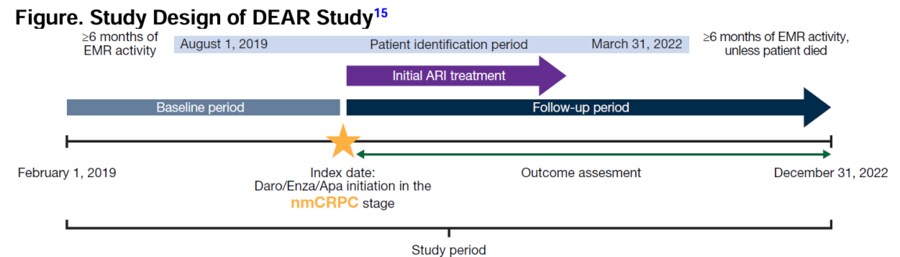
Key: Apa, apalutamide; daro, darolutamide; EMR, electronic medical records; Enza, enzalutamide; mCRPC, metastatic castrationresistant prostate cancer; nmCRPC, non-metastatic castration-resistant prostate cancer.
Figure was published as Fig. 1 in Morgans A, Shore N, Khan N, et al. Comparative real-world evidence on darolutamide, enzalutamide, and apalutamide for nonmetastatic castration-resistant prostate cancer patients in the United States (DEAR). Poster presented at: American Society of Clinical Oncology (ASCO) Annual Meeting; June, 2-6, 2023; Chicago, IL. [downloaded 27 January 2026] Copyrights remain with the original source or as denoted therein.
- Outcomes assessed in the DEAR study included: a composite endpoint of ARI discontinuation or progression to mCRPC; ARI discontinuation (as a separate endpoint) and the reasons for ARI discontinuation; progression to mCRPC (as a separate endpoint) and the time to progression to mCRPC; AE incidence (including AEs of special interest).5
- Cox proportional hazards models were used to compare time to the composite endpoint, time to ARI discontinuation, and time to progression to mCRPC between treatment cohorts, before and after adjusting for the following observed baseline factors: Age, race, insurance coverage, index period, baseline prostate-specific antigen (PSA), baseline PSA doubling time (PSADT), time from nmCRPC diagnosis to index date, and Gleason score.
- Sensitivity analyses using inverse probability of treatment weighting (IPTW) were conducted for ARI discontinuation and progression to mCRPC, applying propensity scores to weight the patients.
Results
Patient Characteristics
- Patient baseline characteristics, demographics, and duration of follow-up of the 362 patients treated with darolutamide and 382 patients treated with enzalutamide are presented in Table: Select Baseline Characteristics and Demographics in DEAR Study.
Table. Select Baseline Characteristics and Demographics in DEAR Study 5
| Characteristic | Darolutamide (n=362) | Enzalutamide (n=382) |
Age, median (range), years | 80 (53-98) | 79 (55-99) |
Race, n (%) | ||
White | 238 (65.7) | 254 (66.5) |
Black/African American | 80 (22.1) | 82 (21.5) |
Other or unknowna | 44 (12.2) | 46 (12.0) |
Insurance coverage, n (%) | ||
Commercial | 103 (28.5) | 88 (23.0) |
Public | 247 (68.2) | 287 (75.1) |
Unknown | 12 (3.3) | 7 (1.8) |
Index period, n (%) | ||
2019-2020 | 203 (56.1) | 255 (66.8) |
2021-2022 | 159 (43.9) | 127 (33.2) |
PSAb level, median (range), ng/mL | 3.3 (0-321.4) | 3.6 (0-417.0) |
PSADTc , median (range), months | 6.8 (0-100.0) | 6.4 (0.6-100.0) |
PSADT groupc , months, n (%) | ||
≤6 | 120 (33.1) | 119 (31.2) |
>6 and ≤10 | 64 (17.7) | 51 (13.4) |
>10 | 85 (23.5) | 81 (21.2) |
Missing | 93 (25.7) | 131 (34.3) |
Gleason score at initial PC diagnosisd , n (%) | ||
4-7 | 161 (44.5) | 139 (36.4) |
8-10 | 133 (36.7) | 153 (40.1) |
Missing | 68 (18.8) | 90 (23.6) |
Time from nmCRPC to index date, median (range), months | 5.3 (0-247.9) | 3.4 (0-130.0) |
Follow-up, median (range), months | 22.2 (2.2-40.3) | 22.7 (0.9-41.5) |
Patients starting at approved ARI dosee , n (%) | ||
Yes | 351 (97.0) | 360 (94.2) |
No | 11 (3.0) | 22 (5.8 |
Key: ARI, androgen receptor inhibitor; EMR, electronic medical record; nmCRPC, non-metastatic castration-resistant prostate cancer; PC, prostate cancer; PSA, prostate-specific antigen; PSADT, prostate-specific antigen doubling time. aIncludes self-reported American Indian or Alaska Native, Hispanic or Latino, other race, and not reported. bValue closest to index date (darolutamide, n=340; enzalutamide, n=345). cPSADT is calculated using the Sloan Kettering methodology, which is based on ≥3 PSA values ≥0.2 ng/mL taken ≥1 month apart, within the 12 months prior to index date (darolutamide, n=269; enzalutamide, n=251). PSADT values after 100 months were capped at 100 for 13 patients (across all patients [darolutamide, enzalutamide, and apalutamide]). dHigher scores indicate higher cancer grade. eDarolutamide, 1200 mg; enzalutamide, 160 mg | ||
Table was adapted from Table. Patient Demographic and Baseline Characteristics in George DJ, Morgans AK, Constantinovici N, et al. Androgen Receptor Inhibitors in Patients With Nonmetastatic Castration-Resistant Prostate Cancer. JAMA Netw Open. 2024;7(8):e2429783. PMID: 39190308 https://www.ncbi.nlm.nih.gov/pubmed/39190308 [downloaded 27 January 2026] Copyrights remain with the original source or as denoted therein.
Outcomes
- A lower proportion of patients in the darolutamide group (37.0%) reached the composite endpoint of treatment discontinuation or progression to mCRPC compared to the enzalutamide group (52.6%).
- In a Cox proportional hazards model adjusting for baseline factors, darolutamide-treated patients had a 33.8% (HR, 0.66 [95% CI, 0.53-0.84]) reduced risk of reaching the composite endpoint compared to enzalutamide.
- A lower proportion of patients in the darolutamide group (30.4%) discontinued treatment compared to the enzalutamide group (40.8%).
- In a Cox proportional hazards model adjusting for baseline factors, darolutamide-treated patients had a 27.4% (HR, 0.73 [95% CI, 0.56-0.94]) reduced risk of treatment discontinuation compared with enzalutamide.
- In the IPTW analysis, darolutamide-treated patients had a 25.5% (HR, 0.75 [95% CI, 0.58-0.96]) reduced risk of discontinuation compared with enzalutamide.
- The two most common reasons for treatment discontinuation (darolutamide vs enzalutamide) included AEs (10.2% vs 14.4%) and progression to mCRPC/death (8.3% vs 12.0%). Other reasons included switching to another ARI, cost/reimbursement factors, other, and unknown.
- A lower proportion of patients in the darolutamide group (17.7%) progressed to mCRPC compared to the enzalutamide group (28.3%).
- In a Cox proportional hazards model adjusting for baseline factors, darolutamide-treated patients had a 40.6% (HR, 0.59 [95% CI, 0.43-0.82]) reduced risk of progression to mCRPC compared with enzalutamide.
- In the IPTW analysis, darolutamide-treated patients had a 39.6% (HR, 0.60 [95% CI, 0.44-0.83]) reduced risk of progression to mCRPC compared with enzalutamide.
- A lower proportion of darolutamide-treated patients (24.9%) had AEs compared to enzalutamide (29.3%) (Table: Adverse Event).
Table. Adverse Events 16
| AEa , n (%) | Darolutamide (n=362) | Enzalutamide (n=382 |
Any AE | 90 (24.9) | 112 (29.3) |
AEs of special interest | 54 (14.9) | 67 (17.5) |
Fatigue | 41 (11.3) | 53 (13.9) |
Rash | 8 (2.2) | 3 (0.8) |
Cognitive and memory impairment | 5 (1.4) | 8 (2.1) |
Fall | 3 (0.8) | 5 (1.3) |
Hypertension | 1 (0.3) | 3 (0.8) |
Fracture | 0 | 0 |
Key: AE, adverse event; ARI, androgen receptor inhibitor; CNS, central nervous system. aAEs recorded during each ARI treatment and up to 30 days after discontinuation. Some patients experienced multiple AEs | ||
Table was adapted from Table. 2 in Supplement to: George DJ, Morgans AK, Constantinovici N, et al. Androgen Receptor Inhibitors in Patients With Nonmetastatic Castration-Resistant Prostate Cancer. JAMA Netw Open. 2024;7(8):e2429783. PMID: 39190308 https://www.ncbi.nlm.nih.gov/pubmed/39190308 [downloaded 27 January 2026] Copyrights remain with the original source or as denoted therein.
DEAR-EXT Study
George, et al (2024)6 reported results from DEAR-EXT, the 1-year extension of DEAR with 3 additional endpoints (PSA response, MFS, and OS). George, et al (2025)7 reported results of the race subgroup analysis.
Study Design/Methods
- DEAR-EXT study is an expansion of DEAR with 1 year additional inclusion and follow-up.6 The inclusion and exclusion criteria were the same as for DEAR. Patients were included between 01 August 2019 – 31 March 2023 (Figure: Study Design of DEAR-EXT Study).
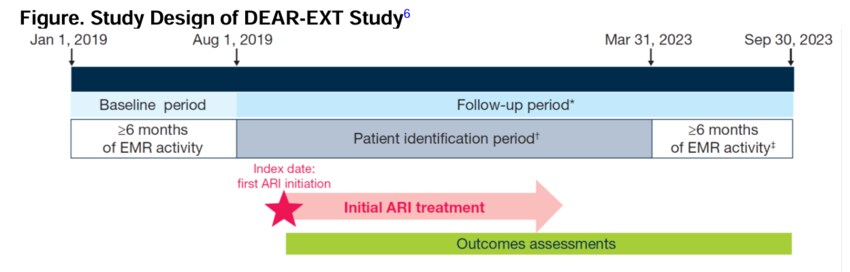
Key: ARI, androgen receptor inhibitor; EMR, electronic medical records.
*Follow-up period: time from index date until date of last EMR activity, end of study period, or death, whichever occurred earliest.
†Patient identification and outcomes assessments based on EMR data provided by Precision Point Specialty Analytics, supplemented with information retrieved from patient charts.
‡Unless the patient died sooner than 6 months from the index date.
Figure was published as Fig. 1 in George D, Morgans A, Khan N, et al. US real-world utilization and outcomes of darolutamide, enzalutamide, and apalutamide for nonmetastatic castration-resistant prostate cancer (nmCRPC): DEAR-EXT study. Poster presented at: American Society of Clinical Oncology (ASCO) Quality Care Symposium (QCS) Annual Meeting; September, 27-28, 2024; San Francisco, CA. [downloaded 27 January 2026] Copyrights remain with the original source or as denoted therein.
- In addition to the endpoint evaluated in DEAR, PSA response rate (decrease of ≥90% from the baseline level [PSA90]), MFS, and OS were assessed.
Results
Patient Characteristics
- Patient characteristics of the 565 darolutamide-treated and 609 enzalutamide-treated patients included in DEAR-EXT are summarized in Table: Baseline Characteristics and Demographics in DEAR-EXT.
- Throughout the study, an increase was observed in the proportion of patients starting darolutamide (2020, 41%; 2022, 50%), and a decrease was observed in the proportion of patients starting enzalutamide (46% to 36%).
Table. Baseline Characteristics and Demographics in DEAR-EXT6
| Characteristic | Darolutamide (n=565) | Enzalutamide (n=609) |
Age, median (IQR), years | 80 (73-85) | 79 (73-85) |
Race, n (%) | ||
White | 375 (66.4) | 407 (66.8) |
Black | 116 (20.5) | 125 (20.5) |
Othera | 74 (13.1) | 77 (12.6) |
Insurance coverage, n (%) | ||
Commercial | 149 (26.4) | 146 (24.0) |
Public | 380 (67.3) | 441 (72.4) |
Unknown | 36 (6.4) | 22 (3.6) |
Index year, n (%) | ||
2019 (Aug-Dec) – 2020 | 240 (42.5) | 337 (55.3) |
2021-2023 (Jan-Mar) | 325 (57.5) | 272 (44.7) |
Gleason score at initial PC diagnosis, n (%) | ||
<8 | 262 (46.4) | 223 (36.6) |
≥8 | 211 (37.3) | 233 (38.3) |
Missing | 92 (16.3) | 153 (25.1) |
Time from CRPC diagnosis to index date, median (IQR), months | 4.7 (1.2-15.4) | 3.4 (0.4-15.0) |
PSA, median (IQR), ng/mL | 2.9 (1.1-7.0) | 3.2 (1.0-8.5) |
PSADT, median (IQR), months | 7.8 (4.7-12.5) | 6.9 (3.8-12.9) |
Patients starting at approved ARI doseb , n (%) | 549 (97.2) | 584 (95.9) |
Follow-up, median (IQR), months | 26.2 (18.0-36.5) | 26.2 (15.1-38.6) |
Key: ARI, androgen receptor inhibitor; CRPC, castration-resistant prostate cancer; IQR, interquartile range; PSA, prostatespecific antigen; PSADT, prostate-specific antigen doubling time. a Includes American Indian or Alaska Native, Hispanic or Latino, Native Hawaiian or other Pacific Islander, and unknown or unspecified other race bApproved doses are: darolutamide, 1200 mg; enzalutamide, 160 mg. | ||
Table was adapted from Table. 1 in George D, Morgans A, Khan N, et al. US real-world utilization and outcomes of darolutamide, enzalutamide, and apalutamide for nonmetastatic castration-resistant prostate cancer (nmCRPC): DEAR-EXT study. Poster presented at: American Society of Clinical Oncology (ASCO) Quality Care Symposium (QCS) Annual Meeting; September, 27-28, 2024; San Francisco, CA [downloaded 27 January 2026] Copyrights remain with the original source or as denoted therein.
Outcomes
- A lower proportion of patients in the darolutamide group (37.3%) discontinued treatment compared to the enzalutamide group (49.4%). Median time to discontinuation for darolutamide and enzalutamide, respectively, was not reported (NR) and 27.6 months (95% CI, 23.9-35.6) (Figure: Time to Discontinuation).
- In a Cox proportional hazards model adjusting for baseline factors, darolutamide-treated patients had a 27% (HR, 0.732 [95% CI, 0.608-0.882)] reduced risk of treatment discontinuation compared with enzalutamide.
- Reasons for treatment discontinuation (darolutamide vs enzalutamide) included TEAEs (10% vs 15%) and disease progression/death (15% vs 19%).
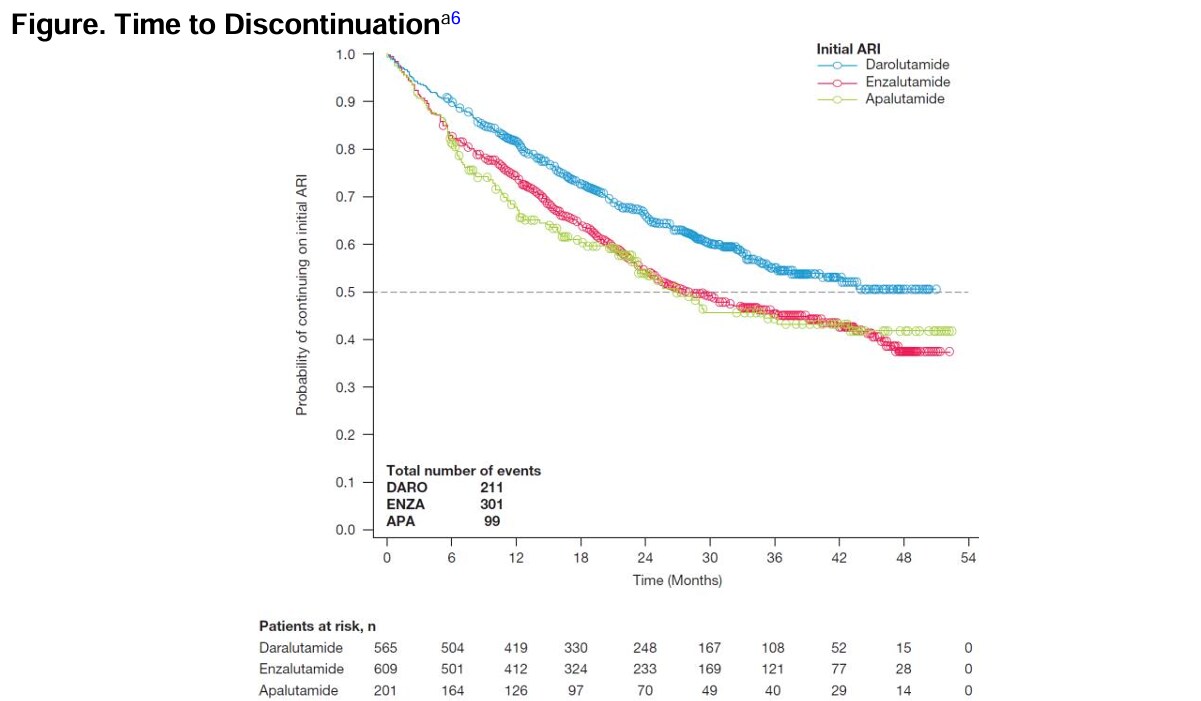
Key: APA, apalutamide; ARI, androgen receptor inhibitor; DARO, darolutamide; ENZA, enzalutamide.
aDiscontinuation defined as initial ARI treatment stop, treatment interruption of >60 days, switch to another ARI, or death.
Figure was published as Fig. 2 in George D, Morgans A, Khan N, et al. US real-world utilization and outcomes of darolutamide, enzalutamide, and apalutamide for nonmetastatic castration-resistant prostate cancer (nmCRPC): DEAR-EXT study. Poster presented at: American Society of Clinical Oncology (ASCO) Quality Care Symposium (QCS) Annual Meeting; September, 27-28, 2024; San Francisco, CA. [downloaded 27 January 2026] Copyrights remain with the original source or as denoted therein.
- A lower proportion of patients in the darolutamide group (22.7%) progressed to mCRPC compared to the enzalutamide group (32.2%) (Figure: Time to mCRPC).
- In a Cox proportional hazards model adjusting for baseline factors, darolutamide-treated patients had a 37% (HR, 0.631 [95% CI, 0.500-0.798]) reduced risk of progression to mCRPC compared with enzalutamide.
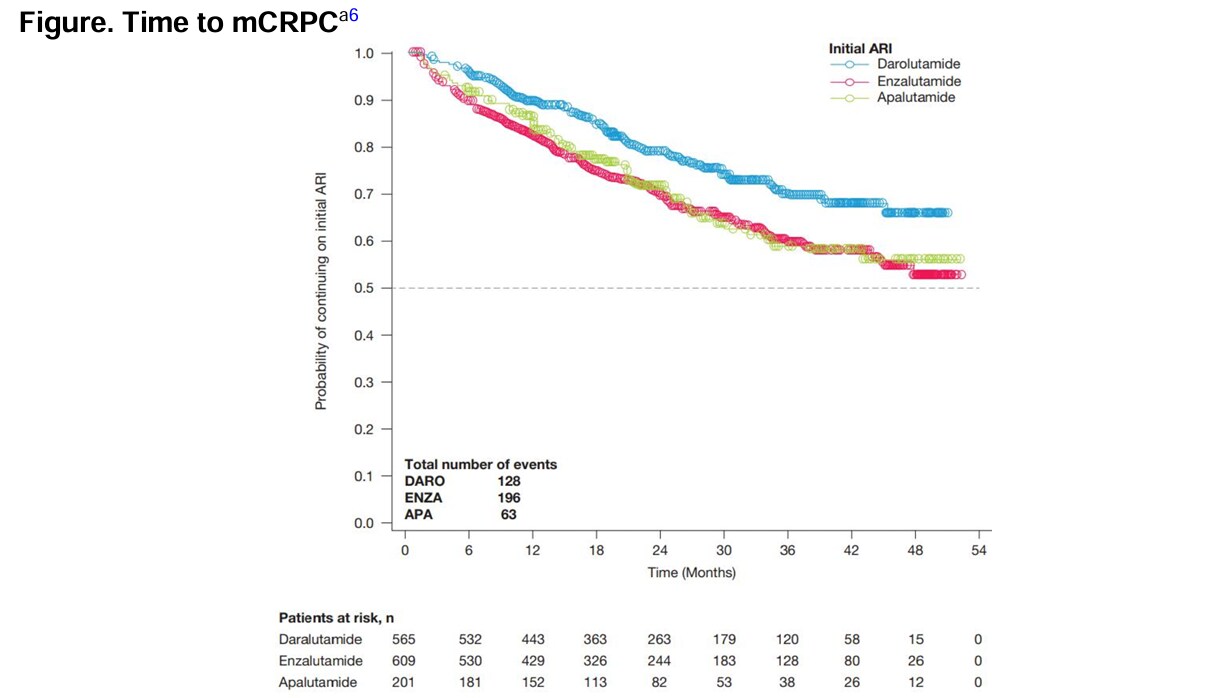
Key: APA, apalutamide; ARI, androgen receptor inhibitor; DARO, darolutamide; ENZA, enzalutamide.
amCRPC defined by recorded evidence of metastases or use of mCRPC treatment.
Source: Figure was published as Fig. 3 in George DJ, Morgans AK, Khan N, et al. US real-world utilization and outcomes of darolutamide, enzalutamide, and apalutamide for nonmetastatic castration-resistant prostate cancer (nmCRPC): DEAR-EXT study.
Figure was published as Fig. 3 in George D, Morgans A, Khan N, et al. US real-world utilization and outcomes of darolutamide, enzalutamide, and apalutamide for nonmetastatic castration-resistant prostate cancer (nmCRPC): DEAR-EXT study. Poster presented at: American Society of Clinical Oncology (ASCO) Quality Care Symposium (QCS) Annual Meeting; September, 27-28, 2024; San Francisco, CA. [downloaded 27 January 2026] Copyrights remain with the original source or as denoted therein.
- MFS was also analyzed (Figure: MFS).
- In a Cox proportional hazards model adjusting for baseline factors, darolutamide-treated patients had a 35% (HR, 0.647 [95% CI, 0.529-0.791]) reduced risk of metastasis or death compared with enzalutamide.
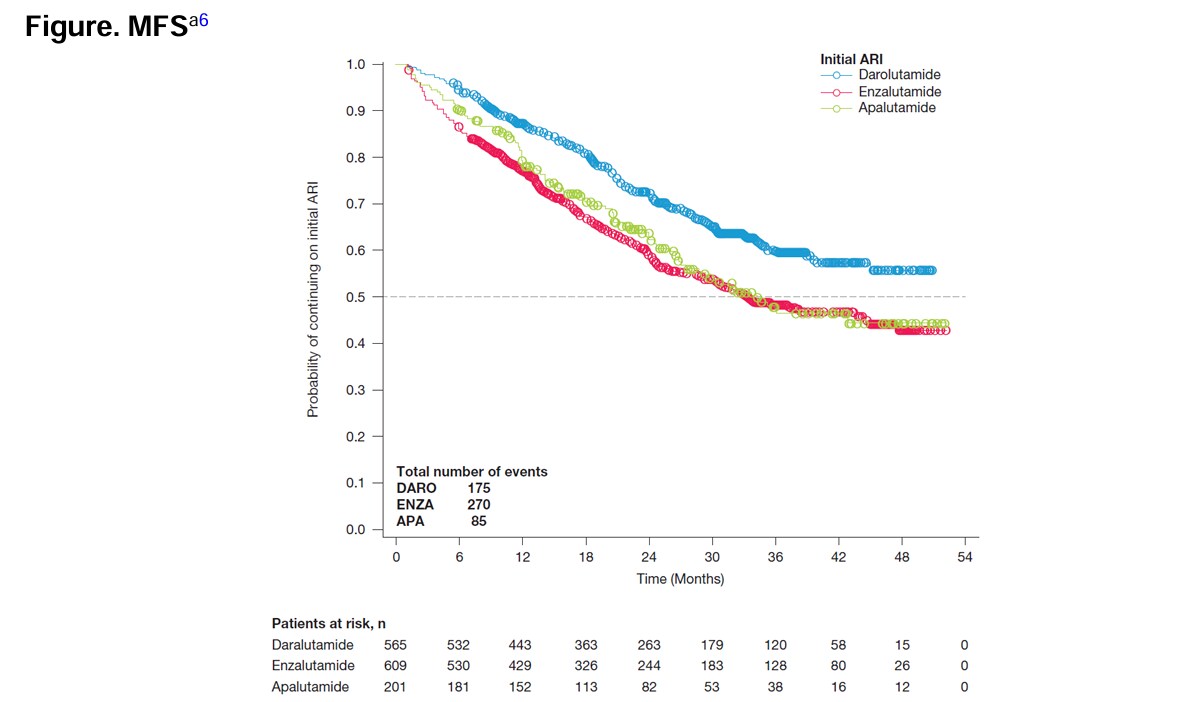
Key: APA, apalutamide; ARI, androgen receptor inhibitor; DARO, darolutamide; ENZA, enzalutamide; MFS, metastasis-free survival.
aMFS was calculated from index date to earliest of date of mCRPC progression or date of death (any cause).
Figure was published as Fig. 4 in George D, Morgans A, Khan N, et al. US real-world utilization and outcomes of darolutamide, enzalutamide, and apalutamide for nonmetastatic castration-resistant prostate cancer (nmCRPC): DEAR-EXT study. Poster presented at: American Society of Clinical Oncology (ASCO) Quality Care Symposium (QCS) Annual Meeting; September, 27-28, 2024; San Francisco, CA. [downloaded 27 January 2026] Copyrights remain with the original source or as denoted therein.
- PSA response rates and OS probabilities at 12, 24, and 36 months were numerically higher for darolutamide vs enzalutamide (Table: PSA Response and OS Probability Over Time).
Table. PSA Response and OS Probability Over Time 6
| Outcome | Darolutamide (n=565) | Enzalutamide (n=609) |
PSA response, patients with event (%) | ||
PSA90 | 65 | 64 |
<0.2 ng/mL | 53 | 51 |
OS, survival probability (%) | ||
12 months | 96 | 92 |
24 months | 88 | 78 |
36 months | 78 | 71 |
Key: OS, overall survival; PSA, prostate-specific antigen; PSA90, ≥90% reduction in PSA from index date. | ||
Table was adapted from Table. 2 in George D, Morgans A, Khan N, et al. US real-world utilization and outcomes of darolutamide, enzalutamide, and apalutamide for nonmetastatic castration-resistant prostate cancer (nmCRPC): DEAR-EXT study. Poster presented at: American Society of Clinical Oncology (ASCO) Quality Care Symposium (QCS) Annual Meeting;September, 27-28, 2024; San Francisco, CA [downloaded 27 January 2026] Copyrights remain with the original source or as denoted therein.
- TEAEs of interest occurring during ARI treatment are summarized in Table: TEAEs of Interests Occurring During ARI Treatment.
Table. TEAEs of Interests Occurring During ARI Treatment 6
| Outcome, n (%) | Darolutamide (n=565) | Enzalutamide (n=609) |
Any TEAE | 142 (25.1) | 173 (28.4) |
Any TEAE of interest | 92 (16.3) | 103 (16.9) |
Fatigue | 75 (13.3) | 81 (13.3) |
Fall | 4 (0.7) | 9 (1.5) |
Fracture | 0 | 0 |
Rash | 13 (2.3) | 4 (0.7) |
Cognitive and memory impairment | 6 (1.1) | 10 (1.6) |
Hypertension | 2 (0.4) | 6 (1.0) |
Key: AE, adverse event; ARI, androgen receptor inhibitor; TEAE, treatment-emergent adverse event. aAEs commonly associated with ARI therapy. | ||
Table was adapted from Table. 3 in George D, Morgans A, Khan N, et al. US real-world utilization and outcomes of darolutamide, enzalutamide, and apalutamide for nonmetastatic castration-resistant prostate cancer (nmCRPC): DEAR-EXT study. Poster presented at: American Society of Clinical Oncology (ASCO) Quality Care Symposium (QCS) Annual Meeting; September, 27-28, 2024; San Francisco, CA [downloaded 27 January 2026] Copyrights remain with the original source or as denoted therein.
Subgroup Analyses
Race Subgroup Analysis
Patient Characteristics
- In the Black cohort (n=282), 116 and 125 patients were treated with darolutamide and enzalutamide, respectively.7 In the White cohort (n=923), 375 and 407 patients were treated with darolutamide and enzalutamide, respectively.
- Patient characteristics within each race subgroup were well balanced across darolutamide and enzalutamide groups, except:
- The enzalutamide group had more patients in earlier index years (2019-2020) in both Black and White cohorts.
- Gleason score of 4-7 was more common in the darolutamide group compared to the enzalutamide group in both Black and White cohorts.
Outcomes
- In an analysis of ARI discontinuation:
- In the Black cohort, a lower proportion of patients in the darolutamide group (32.8%) discontinued treatment compared to the enzalutamide group (44.8%). Median time to discontinuation for darolutamide and enzalutamide, respectively, was NR and 25.5 months (95% CI, 21.6 months – NR).
- In a Cox proportional hazards model adjusting for baseline factors, the risk of discontinuation was significantly lower for darolutamide compared to enzalutamide (HR, 0.62 [95% CI, 0.40-0.97]).
- Reasons for treatment discontinuation (darolutamide vs enzalutamide) included AEs (9.5% vs 10.4%) and disease progression/death (11.2% vs 16.8%).
- In the White cohort, a lower proportion of patients in the darolutamide group (37.9%) discontinued treatment compared to the enzalutamide group (53.1%). Median time to discontinuation for darolutamide and enzalutamide, respectively, was NR and 26.1 months (95% CI, 22.7-32.8).
- In a Cox proportional hazards model adjusting for baseline factors, the risk of discontinuation was significantly lower for darolutamide compared to enzalutamide (HR, 0.68 [95% CI, 0.54-0.85]).
- Reasons for treatment discontinuation (darolutamide vs enzalutamide) included AEs (9.9% vs 17.4%) and disease progression/death (16.3% vs 20.4%).
- In the Black cohort, a lower proportion of patients in the darolutamide group (32.8%) discontinued treatment compared to the enzalutamide group (44.8%). Median time to discontinuation for darolutamide and enzalutamide, respectively, was NR and 25.5 months (95% CI, 21.6 months – NR).
- In an analysis of MFS:
- In the Black cohort, a lower proportion of patients in the darolutamide group (25.9%) experienced an MFS event compared to the enzalutamide group (35.2%). Median MFS for darolutamide and enzalutamide, respectively, was NR and 47.7 months (95% CI, 32.1 months – NR).
- In a Cox proportional hazards model adjusting for baseline factors, the HR for time to MFS for darolutamide compared to enzalutamide was 0.79 (95% CI, 0.47-1.31).
- In the White cohort, a lower proportion of patients in the darolutamide group (33.6%) experienced an MFS event compared to the enzalutamide group (49.1%). Median MFS for darolutamide and enzalutamide, respectively, was NR and 29.2 months (95% CI, 23.9-33.6).
- In a Cox proportional hazards model adjusting for baseline factors, darolutamide-treated patients had a 40% (HR, 0.60 [95% CI, 0.47-0.75]) reduced risk of metastasis or death compared with enzalutamide.
- In the Black cohort, a lower proportion of patients in the darolutamide group (25.9%) experienced an MFS event compared to the enzalutamide group (35.2%). Median MFS for darolutamide and enzalutamide, respectively, was NR and 47.7 months (95% CI, 32.1 months – NR).
LITERATURE SEARCH
A literature search of Embase® , PubMed, and/or other resources, including internal/external databases, was conducted pertaining to this topic on 26 January 2026. Retrospective real-world studies including <1000 patients may be available in the published literature.
REFERENCES
All the references were accessed on the abovementioned literature search date.
- Moilanen AM, Riikonen R, Oksala R, et al. Discovery of ODM-201, a new-generation androgen receptor inhibitor targeting resistance mechanisms to androgen signalingdirected prostate cancer therapies. Sci Rep. 2015;5:12007. PMID: 26137992 https://www.ncbi.nlm.nih.gov/pubmed/26137992
- Williams S MN, O’Daly O. Significant localized reduction in cerebral blood flow (CBF) in regions relevant to cognitive function with enzalutamide (ENZA) compared to darolutamide (DARO) and placebo (PBO) in healthy volunteers. J Clin Oncol. 2020;38(suppl 6):326. PMID: https://ascopubs.org/doi/abs/10.1200/JCO.2020.38.6_suppl.326
- Halabi S, Jiang S, Terasawa E, et al. Indirect Comparison of Darolutamide versus Apalutamide and Enzalutamide for Nonmetastatic Castration-Resistant Prostate Cancer. J Urol. 2021;206(2):298-307. PMID: 33818140 https://www.ncbi.nlm.nih.gov/pubmed/33818140
- Suzuki K, Khan N, Taguchi T, et al. Androgen Receptor Signaling Inhibitors in NonMetastatic Castration-Resistant Prostate Cancer in Japan: The ARASHI Study. Int J Urol. 2025;32:1853-1861. PMID: 41044801 https://www.ncbi.nlm.nih.gov/pubmed/41044801
- George DJ, Morgans AK, Constantinovici N, et al. Androgen Receptor Inhibitors in Patients With Nonmetastatic Castration-Resistant Prostate Cancer. JAMA Netw Open. 2024;7(8):e2429783. PMID: 39190308 https://www.ncbi.nlm.nih.gov/pubmed/39190308
- George D, Morgans A, Khan N, et al. US real-world utilization and outcomes of darolutamide, enzalutamide, and apalutamide for nonmetastatic castration-resistant prostate cancer (nmCRPC): DEAR-EXT study. Poster presented at: American Society of Clinical Oncology (ASCO) Quality Care Symposium (QCS) Annual Meeting; September, 27-28, 2024; San Francisco, CA.
- George D, Morgan A, Khan N, et al. Real-world use and outcomes of darolutamide (DARO), enzalutamide (ENZA), and apalutamide (APA) for nonmetastatic castrationresistant prostate cancer (nmCRPC): Race subgroup analysis. Poster presented at: American Society of Clinical Oncology Genitourinary (ASCO-GU) Annual Meeting; February, 13-15, 2025; San Francisco, CA.
- Signorovitch JE, Sikirica V, Erder MH, et al. Matching-adjusted indirect comparisons: a new tool for timely comparative effectiveness research. Value Health. 2012;15(6):940-7. PMID: 22999145 https://www.ncbi.nlm.nih.gov/pubmed/22999145
- Real-World Evidence. The United States Food and Drug Administration (FDA). Updated 23 January 2026. Accessed via https://www.fda.gov/science-research/science-and-research-special-topics/real-world-evidence
- Di Maio M, Perrone F, Conte P. Real-World Evidence in Oncology: Opportunities and Limitations. Oncologist. 2020;25(5):e746-e752. PMID: 31872939 https://www.ncbi.nlm.nih.gov/pubmed/31872939
- Sarkar S, Seshadri D. Conducting record review studies in clinical practice. J Clin Diagn Res. 2014;8(9):JG01-4. PMID: 25386466 https://www.ncbi.nlm.nih.gov/pubmed/25386466
- Derman BA, Belli AJ, Battiwalla M, et al. Reality check: Real-world evidence to support therapeutic development in hematologic malignancies. Blood Rev. 2022;53:100913. PMID: 35272867 https://www.ncbi.nlm.nih.gov/pubmed/35272867
- Suzuki K, Khan N, Taguchi T, et al. Use and clinical outcomes of androgen receptor inhibitors (ARIs) for nonmetastatic castration-resistant prostate cancer (nmCRPC) at labeled doses in Japan. Poster presented at: American Society of Clinical Oncology Genitourinary (ASCO-GU) Annual Meeting; February, 13-15, 2025; San Francisco, CA.
- Supplement to: Suzuki K, Khan N, Taguchi T, et al. Androgen Receptor Signaling Inhibitors in Non-Metastatic Castration-Resistant Prostate Cancer in Japan: The ARASHI Study. Int J Urol. 2025;32:1853-1861. PMID: 41044801 https://pubmed.ncbi.nlm.nih.gov/41044801/
- Morgans A, Shore N, Khan N, et al. Comparative real-world evidence on darolutamide, enzalutamide, and apalutamide for nonmetastatic castration-resistant prostate cancer patients in the United States (DEAR). Poster presented at: American Society of Clinical Oncology (ASCO) Annual Meeting; June, 2-6, 2023; Chicago, IL.
- Supplement to: George DJ, Morgans AK, Constantinovici N, et al. Androgen Receptor Inhibitors in Patients With Nonmetastatic Castration-Resistant Prostate Cancer. JAMA Netw Open. 2024;7(8):e2429783. PMID: 39190308 https://www.ncbi.nlm.nih.gov/pubmed/39190308


Follow Us